SCE Update: June 1 Rate Changes and RAMP Submission
Today's briefing looks at two rate-related filings from Southern California Edison.
JUNE 1, 2026 RATES
SCE filed Advice Letter 5829-E to implement a June 1 consolidated revenue requirement and rate update reflecting CPUC and FERC approvals, balancing account true-ups, wildfire cost changes, and the removal of expiring charges.
SCE's authorized revenue requirement declines by $26.4 million relative to January 1 levels, producing an approximately 0.1% system-average rate decrease for bundled customers. A typical non-CARE residential customer using 500 kWh per month will see an estimated $0.15 monthly decrease; CARE customers will see a $0.13 reduction.
The largest upward driver is a $380.7 million distribution revenue increase tied to SCE's wildfire self-insurance program. After SCE entered into 2025 wildfire settlement agreements expected to exceed $1 billion, it triggered an adjustment mechanism that raises its 2026 self-insurance revenue requirement from $274 million currently in rates to $650 million. This constitutes an increase of $376 million before Franchise Fees and Uncollectibles.
SCE will amortize the increase over 12 months to moderate rate impacts. Offsetting that increase are:
- An $84.5 million reduction in transmission balancing account recovery reflecting an overcollection in the Transmission Access Charge Balancing Account Adjustment;
- A $73.4 million credit from the 2023 ERRA review;
- A $240.3 million reduction in energy efficiency funding requirements; and
- The expiration of $34.7 million in Thomas Fire Catastrophic Event Memorandum Account recovery rolling off rates after May 31.
Smaller items include a $15.4 million increase for the Electric Program Investment Charge RD&D and renewables program, $6.8 million for the 2026 Flex Alert paid media campaign, and $3.6 million annually for SCE's tariff on-bill financing pilot for residential clean-energy upgrades.
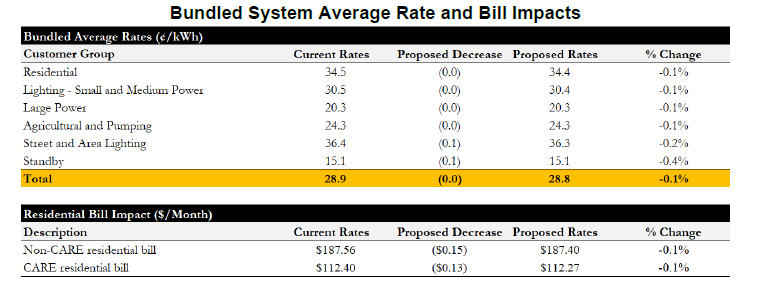
INSTANT ANALYSIS: Beneath the near-flat system average sits a major redistribution of cost drivers: wildfire self-insurance rises by about $381 million after the utility triggered an approved adjustment mechanism tied to 2025 wildfire settlements. Meanwhile, offsets from transmission overcollections, ERRA credits, lower energy-efficiency funding, and the expiration of Thomas Fire recovery keep bill impacts modest. For large customers tracking distribution cost growth and wildfire exposure, the filing is another reminder that California utility rates remain under steady upward pressure even when bill impacts appear benign. The TACBAA reduction shows how balancing account timing can temporarily absorb rate pressure without altering the broader cost trajectory.
RISK ASSESSMENT/MITIGATION
Edison filed its 2026 Risk Assessment Mitigation Phase application at the CPUC as the safety-risk foundation for its Test Year 2029 General Rate Case. The company identifies 10 RAMP risks:
- Wildfire and Public Safety Power Shutoffs;
- Overhead Equipment Failure;
- Underground Equipment Failure;
- Seismic;
- Public Safety Risk Not Attributable to Asset Failure;
- Major Physical Security Incident;
- Cyber Attack;
- Hydro Dam Safety;
- Employee Safety; and
- Contractor Safety.
The January 2025 Southern California fires dominate SCE's case for planning around tail-risk events beyond historical experience. SCE developed an enhanced Wildfire Integrated Model and a climate-informed variant using data underlying the forthcoming California Fifth Climate Change Assessment, which has not yet been released.
Grid hardening runs through a Benefit-Cost Ratio screen at the circuit level. SCE selects either covered conductor or targeted undergrounding based on whichever yields the higher BCR, provided at least one exceeds 1.0. Where neither clears that threshold, no proactive hardening is proposed; vegetation management, inspections, and PSPS continue, but no grid investment moves forward.
Rapid Earth Fault Current Limiters (REFCLs), substation-based protection devices that suppress ground-fault current when an energized conductor contacts the ground, are prioritized separately based on execution feasibility at circuits where covered conductor hardening is already prevalent. Covered conductor raises wind-speed thresholds but does not remove shutoff risk when winds exceed them.
SCE argues Benefit-Cost Ratios are one input, not the determinant; operational constraints, feasibility, and execution limits remain in the equation.
INSTANT ANALYSIS: The 2026 RAMP is a capital intentions map. It previews the size and geography of SCE's 2029 wildfire hardening requests.
The Benefit-Cost Ratio is where things may get contentious. SCE proposes no proactive grid hardening on circuits where the benefit-cost ratio falls below 1.0, leaving vegetation management, inspections, and PSPS as the remaining mitigation tools in those areas. Intervenors will argue that communities on sub-1.0 circuits are being left without physical protection because of a cost screen, not because the risk is low. If that argument gains traction, it may force SCE to revisit its 2029 hardening scope before its GRC is filed.
SCE's climate-informed wildfire modeling carries similar vulnerabilities. Rather than relying on historical fire data, SCE is incorporating forward-looking climate projections into the risk calculations that drive its entire mitigation prioritization. The CPUC's safety staff has not yet evaluated that methodology. A successful challenge to the underlying assumptions would not just affect the climate modeling, it would move the risk scores, and with them, the hardening investments SCE plans to ask ratepayers to fund in 2029.