WEDNESDAY AGGREGATE: SB 884 Cost Questions; Rule 30 Recommendations; and Climate Credit Changes
Today’s aggregate covers:
- Utility responses in the Senate Bill 884 undergrounding proceeding (re: Benefit-Cost Ratios);
- Cal Advocates’ recent fifth-floor communications on PG&E's Rule 30;
- A possible affordability-focused redesign of the Climate Credit; and
- A draft resolution streamlining IOU Low Carbon Fuel Standard spending plans.
ELECTRIC LINE UNDERGROUNDING
PG&E, SCE and SDG&E filed their responses to ALJ Regina DeAngelis's June 18 ruling in the Senate Bill 884 undergrounding proceeding, which asked how the utilities intend to build and verify benefit-cost ratios (BCR) in Phase 2 applications.
- SCE largely sat out, saying it has no current plan to submit an electrical undergrounding plan, leaving PG&E and SDG&E to address the substance.
- PG&E says its project-cost estimates will follow AACE-style maturity classes, with early projects at rough-order-of-magnitude levels that may be off by -50% to +100%, moving toward -5% to +10% as engineering advances.
- Notably, PG&E treats cost estimates and risk-reduction estimates as separate categories with separate standards. Cost estimates mature as engineering advances; wildfire-risk modeling does not achieve comparable precision at any stage. Consequently, PG&E does not propose milestone-specific BCR accuracy ranges, and instead applies a flat 30% uncertainty factor when comparing mitigation alternatives.
- On O&M, PG&E says its assumptions are built mainly from 2023 General Rate Case forecasts and normalized historical data. Undergrounding is assumed to eliminate PSPS-related and vegetation-management O&M, cut patrols, inspections and emergency work by approximately 90%, and reduce routine maintenance more modestly.
- PG&E does not plan to track avoided O&M savings project by project after construction, arguing those savings are counterfactual and unfold over asset lives of 48 to 55 years.
- SDG&E breaks from PG&E on this point: it says it will track actual O&M costs at the project level after construction, even though it agrees avoided savings are not directly observable either way.
The filing also shows how PG&E wants to handle risks that may not be fully captured in the model. For evacuation constraints, tree-strike exposure and PSPS geography, PG&E says engineers will conduct more granular reviews outside the systemwide risk model. Those reviews could support targeted undergrounding or hybrid designs where full undergrounding isn't cost-effective, provided the hybrid option stays within PG&E's 30% uncertainty band and outperforms the full-undergrounding alternative.
INSTANT ANALYSIS: PG&E is asking the CPUC not to treat SB 884 benefit-cost ratios as a mechanical ranking tool. Its main argument is that the cost side of the BCR gets more refined as projects mature, while the risk side stays a modeled estimate indefinitely. That gives PG&E room to apply engineering judgment when localized evacuation, vegetation, or PSPS conditions aren't captured cleanly by the model. The exception is defined, not open-ended. A hybrid design qualifies only if its BCR stays within 30% of the overhead alternative's BCR and beats the underground alternative's.
PG&E's O&M claims deserve scrutiny. It projects major long-term avoided-cost benefits from undergrounding, but will not audit those savings project by project after construction (only through periodic GRC review at the program level). SDG&E commits to tracking actual post-construction O&M costs, though it treats avoided savings the same way PG&E does.
LARGE LOAD TRANSMISSION
Cal Advocates recently engaged in multiple ex parte communications in PG&E's Rule No. 30 proceeding. Cal Advocates argued Rule 30 should prevent ratepayers from subsidizing billions in transmission infrastructure, noting that data center-related upgrades approved over the past two years exceed $4 billion.
Its recommendation for Type 4 network upgrade costs is a single proposal: an interim $50 million advance, or $667/kW, until a permanent method is developed. An attached handout lists three other approaches for comparison, not as Cal Advocates alternatives:
- A CAISO-tariff-modeled option tying advances to contracted capacity;
- The Resolution E-5420 method, capping refunds at 75% of net revenue; and
- PG&E's own "customer responsibility" proposal, which Cal Advocates says would produce no upfront financing because it excludes CAISO transmission planning process upgrades and upgrades not solely triggered by one customer.
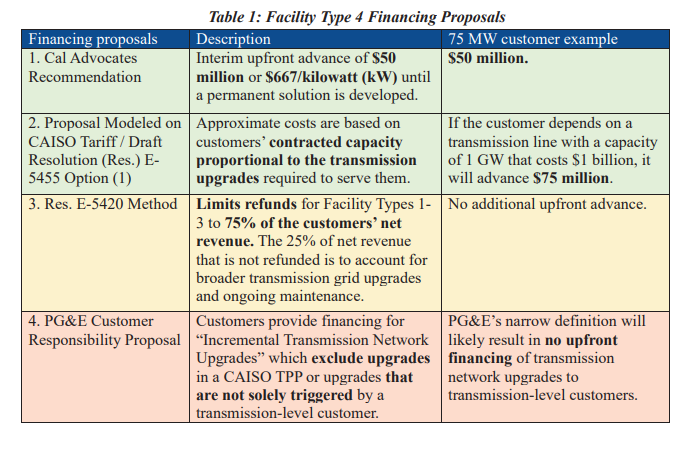
Cal Advocates urged the CPUC to reject PG&E's Base Annual Revenue Calculation refund structure and interest payments on refunds, arguing refunds should track actual revenues rather than forecasts so customers aren't refunded before load materializes. It characterized interest refunds as an unnecessary ratepayer burden, saying no other jurisdiction pursues them for large-load interconnections. It also noted that none of the large-load advice letters PG&E has filed in this proceeding have requested or received interest.
Cal Advocates also backed a minimum demand charge on a fixed load ramp over PG&E's customer-specific ramp, citing gamesmanship risk. It said several other provisions have broader agreement among the proceeding's parties, including minimum contract terms/early termination fees and lowest-cost rules for applicant-built facilities.
INSTANT ANALYSIS: Cal Advocates wants Rule 30 built on cost causation before PG&E's large-load queue becomes a ratepayer problem. The dispute is over Type 4 upgrades: PG&E's "incremental" definition excludes CAISO-Transmission Planning Process upgrades and anything not solely triggered by one customer, which Cal Advocates says leaves ratepayers financing most of the transmission build. The $50 million figure is a placeholder pending a permanent method. The real question is whether large-load customers can reserve transmission capacity now and push the financing risk onto other ratepayers.
CLIMATE CREDIT
CPUC President John Reynolds issued a ruling directing the Climate Credit toward affordability, electrification, and usage-based need. The ruling states that the CPUC's earlier principle (withholding the credit during high-cost periods to preserve the carbon price signal) no longer reflects current statutory direction.
Assembly Bill 1207, the governor's affordability directive (Executive Order N-5-24), and a recent CPUC decision each point toward providing greater assistance during high-cost periods, particularly for high-usage and low-income customers.
For the electric credit, Reynolds intends to prioritize three options:
- Retaining the status quo with possible refinements;
- Adopting his own proposal concept; or
- Considering proposals from parties.
His concept would replace the flat per-household credit with a modular structure. One version ties the number of credits to baseline usage: customers below baseline receive one credit, customers above baseline receive two, and CARE customers above baseline receive three.
A second version ties the number of credits to climate zone, providing larger credits in hotter regions while relying on existing utility billing infrastructure. Reynolds also asks parties to address whether a purely volumetric, cents-per-kWh credit would better serve affordability and electrification goals than either tiered approach.
The gas credit receives more limited treatment. CARB's 2026 Cap-and-Invest updates will shift an increasing share of gas utility allowance value to electric utilities beginning in 2028, reaching 70% by 2031, with the remaining 30% reserved primarily to benefit low-income gas customers. Reynolds's concept would leave gas credit timing, eligibility, and distribution unchanged before 2028.
Beginning in 2028, the reserved 30% would be allocated among CARE gas customers, while the remaining, shrinking allowance pool would be distributed among non-CARE customers. This approach depends on CARE customers representing a small enough share of gas customers that they fare better under the reserved allocation than under the current equal-distribution structure.
Opening comments are due July 24, with reply comments July 31. A workshop is scheduled for August 10. Party proposals are due September 14, and utility implementation assessments are due October 9.
INSTANT ANALYSIS: This ruling reflects a change in the underlying rationale for the Climate Credit. The program was originally designed to preserve a carbon price signal by avoiding payment during high-cost periods. Reynolds's guidance reorients the credit toward affordability, directing greater assistance to customers facing higher costs.
Both electric concepts raise distributional questions the ruling itself acknowledges. Usage and climate zone correlate with cost burden, but not precisely with income. A high-usage customer in a hot climate zone is not necessarily low-income, and Reynolds specifically raises the concern that added assistance could disproportionately benefit higher-income customers in hotter zones.
The gas credit receives comparatively little attention because CARB's allowance reallocation is already reducing the pool available for distribution. Reynolds's approach limits Commission effort in this phase to preserving benefits for CARE customers as that pool contracts, rather than pursuing a broader redesign.
LOW CARBON FUEL STANDARD
Draft Resolution E-5463 streamlines the process by which PG&E, SDG&E and SCE seek approval for programs funded by Low Carbon Fuel Standard credit proceeds. If ultimately adopted, the draft resolution would replace the current ad hoc advice-letter process with a fixed annual cycle:
- New implementation plans would be due January 31; and
- Budget extensions would proceed through the September 30 forecast advice letter. If that letter remains unresolved by year-end, the prior year's budget would remain in effect.
The draft resolution also treats LCFS verification costs as overhead. Separately, medium- and heavy-duty electrification infrastructure would qualify as equity spending when it meets CARB requirements. The draft resolution accepts that truck emissions benefits may occur along travel corridors rather than only at a vehicle's domicile or charging location.
These provisions respond directly to CARB's revised LCFS rules, which:
- Shifted Clean Fuel Reward funding from light-duty EV rebates toward medium- and heavy-duty vehicle incentives;
- Raised equity-spending requirements to 75% for large and medium IOUs;
- Reduced required utility remittances to the statewide program;
- Expanded the list of preapproved holdback projects; and
- Added third-party verification requirements beginning in 2027.
INSTANT ANALYSIS: The annual filing cycle is primarily administrative. It provides a predictable schedule, which benefits utilities and stakeholders tracking the docket. The substantive change originates with CARB. Funding is moving from light-duty rebates toward medium- and heavy-duty infrastructure. Additionally, the corridor-based approach to equity accounting means a charging site need not be located in a disadvantaged community to count as equity spending, provided the vehicles it serves operate in one. The result is a more expansive funding lane for freight and fleet electrification than previously existed.