SATURDAY BRIEFING: SB 1221 Work Advances as Angeles Link and Southern System Risks Remain Unresolved
Today's briefing looks at:
- A PD establishing the application process for Senate Bill 1221 decarbonization pilots;
- A new ruling in SoCalGas's Phase 1 Angeles Link cost-recovery proceeding;
- SDG&E's Palomar Decarbonization Demonstration Project; and
- More details from SoCalGas's May 15 Annual Customer Forum.
LONG-TERM GAS PLANNING/DECARBONIZATION
Commissioner Karen Douglas issued a proposed decision establishing the application process for Senate Bill 1221 neighborhood decarbonization pilots. The PD authorizes gas corporations to seek approval for voluntary projects that replace gas service with zero-emission alternatives and enable decommissioning of the underlying gas infrastructure.
- The program is capped at 30 pilots statewide. Project slots are allocated primarily between PG&E and SoCalGas/SDG&E by 2024 gas demand (seven each per round across the first two rounds) with one slot reserved for Southwest Gas and one for the smaller CPUC-regulated gas corporations, each usable in either of the first two rounds.
- Application deadlines are December 15, 2026, December 15, 2027, and, per the ordering paragraph, July 1, 2028, if slots remain. (Note: The summary section of the PD states June 1, 2028.)
- Each application must demonstrate, via net present value using the applicant's WACC as the discount rate, that avoided gas infrastructure costs exceed the cost of the zero-emission alternative. The PD requires four separate cost-effectiveness calculations varying the inclusion of non-ratepayer funding and administrative costs; the governing test excludes costs funded by non-ratepayer sources and excludes administrative and outreach costs.
Applications must also:
- Account for electric infrastructure upgrade costs;
- Document outreach and stakeholder coordination;
- Obtain non-binding expressions of interest from at least 67% of property owners before filing;
- Obtain binding notarized consent from that same threshold after Commission approval and before building remediation, appliance removal, or implementation spending begins; and
- Show that substitute service is affordable and adequate, particularly for low-income customers.
Required application contents include:
- Project maps;
- Customer counts;
- Bill-impact estimates at specified percentiles;
- Gas and electric infrastructure analyses;
- Appliance and remediation offerings;
- GHG emissions forecasts using the Avoided Cost Calculator;
- Labor considerations; and
- Cost-recovery proposals.
Behind-the-meter costs must be expensed rather than capitalized; utilities may not earn their authorized rate of return on BTM costs and may propose amortization periods of up to ten years. Comments are due June 18. The earliest the CPUC will consider this item is July 2.
INSTANT ANALYSIS: This is the CPUC's first bona-fide attempt to convert SB 1221 from gas-transition policy into a working project pipeline, and the PD is designed to make that conversion difficult.
A pilot must prove that avoiding gas repair, replacement, or continued operation pays for the zero-emission alternative, using the utility's own cost of capital, excluding costs funded by non-ratepayer sources and excluding administrative and outreach costs from the governing calculation. That points to a limited candidate set: areas with expensive near-term gas work, limited electric upgrade needs, and a customer mix that converts without severe bill or remediation exposure.
The application process (rather than advice letters) keeps every pilot subject to full Commission and intervenor scrutiny, which is where cost allocation, bill-impact assumptions, and electric-grid attribution get contested. The 67% consent requirement adds a second filter: utilities absorb substantial outreach cost before CPUC approval, then must obtain binding notarized consent before building remediation, appliance removal, or implementation spending begins. Projects with weak community support or complicated master-metered properties may not survive that sequence.
Data collection, reporting, evaluation, and the shareholder incentive mechanics are all deferred to Track 4. SB 1221's core rationale is generating lessons about whether targeted gas retirement can work as a ratepayer-beneficial alternative to continued infrastructure spending. Without evaluation criteria in place before pilots launch, that test is harder to interpret when results come in.
If adopted, this PD will establish the first formal test of whether neighborhood-scale gas retirement can work within existing ratemaking discipline.
ANGELES LINK/HYDROGEN
A May 29 ALJ ruling asks parties in SoCalGas’s Angeles Link Phase 1 cost-recovery proceeding to address several questions in light of the Commission’s April 30 Phase 2A denial (D.26-04-034):
- Whether it is just and reasonable for ratepayers, or a subset of ratepayers, to bear Phase 1 costs, and if so, which ratepayers benefited and when recovery should occur;
- Whether the CPUC must reach jurisdiction over Angeles Link to resolve the proceeding or can dispose of it on cost-recovery grounds alone;
- What schedule should govern the remainder of the case, including whether evidentiary hearings are necessary; and
- Whether any other determinations from D.26-04-034 should be considered in the Phase 1 proceeding.
Responses are due June 30, with replies due July 16.
INSTANT ANALYSIS: The CPUC has already rejected ratepayer recovery for the next stage of Angeles Link work where SoCalGas had not shown a sufficient ratepayer benefit. Phase 1 costs now face a related test, and SoCalGas has less to point to: Phase 1 was planning work, not construction, not permitting, and not anything a ratepayer can identify as a delivered project benefit.
The jurisdiction question may be the more consequential one. If the CPUC can resolve this proceeding on cost-recovery grounds alone, it never has to rule on whether Angeles Link is a jurisdictional project, which means that question stays open, unresolved, and available to relitigate later. That is not necessarily bad for SoCalGas, but it forecloses the jurisdictional clarity the company has been seeking since 2022.
In short, Phase 1 recovery is in serious trouble, the schedule is undefined, and the CPUC has given itself every offramp it needs to deny recovery without touching the harder jurisdictional question.
HYDROGEN/DECARBONIZATION
Commissioner Christine Harada issued a scoping memo addressing SDG&E's standalone request to recover costs for the Palomar Decarbonization Demonstration Project. The project is an integrated hydrogen system at the Palomar Energy Center involving on-site hydrogen production, storage, blending in one gas turbine, and hydrogen vehicle fueling.
Note that the CPUC previously denied SDG&E's capital cost recovery request for the project in the utility's 2024 GRC, finding the record lacked enough evidence to show ratepayer value. SDG&E now seeks recovery of $17.4 million in capital costs, $2.6 million in O&M costs through 2036, and an estimated $31.1 million revenue requirement.
The scoped issues fall into three clusters. The first is evidentiary: whether the project produces operational, safety, emissions, decarbonization, and scalability findings that are unique from other research and pilots. The second is financial: total costs, revenue requirement, federal tax credits, public funding, and cost allocation between bundled and unbundled customers. The third is the bottom line: whether ratepayer cost is just and reasonable relative to project value.
Intervenor testimony is due July 31.
 MC
MC
INSTANT ANALYSIS: The scoping memo puts SDG&E back in the same bind it faced in the GRC: the utility has to show that Palomar hydrogen is worth ratepayer money, not merely that it is innovative or aligned with decarbonization policy.
That is a harder showing than it may appear. The CPUC already rejected the project once because SDG&E did not prove ratepayer value. This standalone application gives SDG&E another chance, but the scoped issues press directly on the weak points: public interest, unique operational learning, emissions value, scalability, public funding, tax credits, and allocation between bundled and unbundled customers.
If SDG&E recovers costs through distribution rates, the project could reach a broad customer base even though the hydrogen system is located at a generation facility and appears tied to specific operational use cases. If recovery runs through generation rates, the question becomes whether unbundled customers should pay and whether the project produces benefits extending beyond bundled generation service.
The ruling also keeps the dismissal argument alive in substance, even if the application was not thrown out at the scoping stage. Parties argued that the current filing contains no new facts or evidence beyond what SDG&E presented in the GRC, and the Commission made that the first scoped issue. That frames the case around evidentiary improvement, not hydrogen policy enthusiasm.
SOCALGAS CUSTOMER FORUM
SoCalGas filed its 2026 Post-Forum Report on System Reliability Issues following its May 15 customer forum, which drew approximately 60 participants. The forum covered:
- Operational Flow Orders;
- Minimum flow requirements;
- System reliability transactions;
- Scheduled quantity trades;
- ENVOY updates;
- Cost allocation;
- Operational reliability developments; and
- The Aliso Canyon biennial assessment.
No customer questions or proposals were submitted before the meeting, and most agenda topics drew no questions. Substantive discussion was limited to system reliability transactions.
- Shell asked about Otay Mesa pricing during a September 3, 2025 Southern System Reliability request; SoCalGas said the price spike was addressed in its Annual Compliance Review filing, Advice Letter 6558-G.
- Shell also asked about the Energía Costa Azul LNG Project and the CPUC-rejected North-South, Adelanto-to-Moreno pipeline funding request; SoCalGas said the CPUC will not revisit ECA LNG impacts until operational data shows effects on Southern System customers.
- ConocoPhillips asked whether renewable growth would reduce Southern System Reliability requests; SoCalGas said renewable generation has already affected system demand.
- Jain Global asked whether baseload purchases would resume; SoCalGas said baseload transactions are not feasible under current Rule 41 Safe Harbor requirements and that it has requested changes in its pending ACR advice letter, with CPUC disposition pending.
For more detail, see CRI's same-day forum summary from May 15:
MC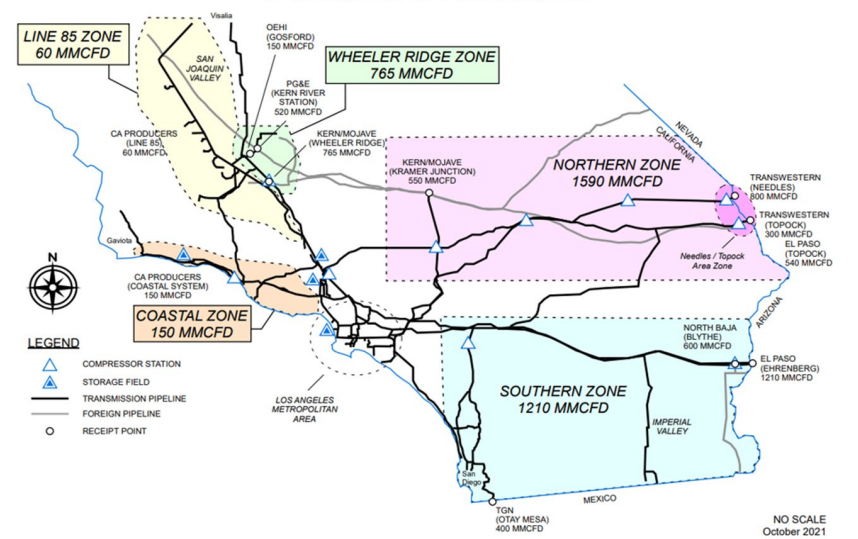
INSTANT ANALYSIS: The Southern System reliability problem has not gone away. Shell's question about the September 2025 Otay Mesa price spike points to the same crucial exposure: when Southern System constraints emerge, customers face reliability actions whose costs and mechanics can become consequential fast. SoCalGas's answer routes the issue into the Annual Compliance Review, where the CPUC evaluates reasonableness after the fact.
The ECA LNG and Adelanto-to-Moreno exchange merits consideration. SoCalGas is indicating that the CPUC will not revisit the rejected pipeline funding request unless operational data shows actual harm to Southern System customers. That leaves the utility in a reactive position: it may need evidence of system failure before it can rebuild the case for infrastructure relief. By the time the data exists, customers will have already experienced the consequences.
The baseload purchase answer may be the most actionable disclosure. SoCalGas has already asked the CPUC to modify Rule 41 Safe Harbor requirements in its pending Annual Compliance Review advice letter. Approval will expand the reliability toolkit. Denial will keep Southern System reliability management dependent on shorter-term transactions and after-the-fact reasonableness review.