MONDAY AGGREGATE: Senate Bill 1221 Implementation; Reining in RNG Costs; PG&E Arrangement with Citizens Energy Corporation
Today's aggregate provides updates on:
- Continued implementation of Senate Bill 1221 and priority zone decarbonization projects;
- An attempt by the CPUC to rein in biomethane costs;
- PG&E's long-term investment arrangement with Citizens Energy Corporation;
- Potential guiding principles for the Avoided Cost Calculator;
- SCE ERRA compliance matters; and
- Ex parte communications involving the Sempra IOU's petition for modification of a 2024 General Rate Case decision.
Parties also filed opening comments on Track 1 proposals in the CPUC's Resource Adequacy rulemaking. If your organization would like an update reviewing all parties' comments on the RA matter, please contact us for a standalone summary and analysis. CRI now offers standalone project pricing.
SENATE BILL 1221 DECARBONIZATION PILOTS
Commissioner Karen Douglas issued a third amended scoping memo in the CPUC's Long-Term Gas Planning docket to refine questions related to the pilot program established under Senate Bill 1221, which directs the CPUC to establish a program under which gas utilities propose pilot projects aimed at cost-effective decarbonization in designated priority zones.
The ruling revises a previously issued scoping memo by clarifying how gas utilities must demonstrate compliance with statutory requirements concerning community coordination and customer participation. Specifically, the memo restates one existing scoping issue and adds a related sub-issue addressing what information utilities must include in their pilot applications to show collaboration with local governments and community organizations, as well as how they will document property-owner consent and provide notice to affected customers and tenants, including those served through master-metered systems.
Parties are invited to comment by March 10, with reply comments due March 17.
INSTANT ANALYSIS: The ruling clarifies what gas utilities must include in their pilot applications to demonstrate local government coordination, community engagement, property-owner consent, and customer notification for participation in decarbonization zone pilots. The CPUC is emphasizing documentation of community participation before approving decarbonization zone pilots. Utilities preparing proposals will need clearer records of outreach and consent, which may lengthen application preparation but does not alter the policy direction of the proceeding.
BIOMETHANE
Commissioner John Reynolds issued a proposed decision that modifies the CPUC's Renewable Gas Standard program created under Senate Bill 1440 to modify biomethane procurement requirements for California's gas utilities.
The PD concludes that the procurement framework adopted in a 2022 decision (D.22-02-025) would impose excessive above-market costs on ratepayers given the early-stage biomethane market and limited feedstock supply.
- To address this, the PD adopts a Cost Containment Mechanism that caps average program rate impacts at 1% of each utility's bundled core customer revenue requirement with a maximum 3% year-over-year increase. The Cost Containment Mechanism is the controlling constraint; the CPUC will not approve contracts that would cause rates to exceed it.
- The PD also reduces the overall biomethane procurement target from 72.8 billion cubic feet annually to 36.4 billion cubic feet and extends the compliance timeline from 2030 to 2035. The prior short-term/medium-term structure is eliminated in favor of a single 2035 deadline. The Diverted Organic Waste procurement goal of 17.6 Bcf remains unchanged, tied to California's Senate Bill 1383 methane-reduction policy.
- The PD opens all feedstocks to bid into utility solicitations while maintaining the dedicated Diverted Organic Waste target and directs utilities to revise their Renewable Gas Procurement Plans via Tier 2 Advice Letters. The 4% livestock biomethane procurement limit is retained.
- The PD removes the previous 2040 delivery cutoff so contracts can extend beyond that date, retains the M-RETS tracking system, and establishes an 80/10/10 Renewable Thermal Certificate unbundling framework: 80% of biomethane by volume stays bundled with Renewable Thermal Certificate retired by the utility; 10% allows the developer to retain the RTC; 10% allows the utility to market it. Unbundled volumes purchased at market rate do not count against the Cost Containment Mechanism.
Utilities are also directed to advice letters addressing landfill eligibility and interconnection cost reductions, respectively. The earliest the CPUC will consider this item is April 9. Comments are due March 26.
INSTANT ANALYSIS: The CPUC is walking back the scale of the Renewable Gas Standard after early procurement revealed high costs and limited biomethane supply. The PD cuts the overall target in half while preserving the full Diverted Organic Waste target, pushes the deadline to 2035, and imposes a strict Cost Containment Mechanism that halts procurement if program costs exceed a 1% average rate impact measured against each utility's bundled core customer revenue requirement.
If the PD is adopted, RNG procurement will continue, but under strict affordability constraints. The program shifts from an aggressive decarbonization mandate to a controlled, ratepayer-limited market experiment. The 80/10/10 Renewable Thermal Certificate unbundling framework is a novel structure worth watching; if it demonstrates cost savings, expect expansion in future proceedings.
TRANSMISSION PROJECTS
A new proposed decision in A.24-03-009, if adopted, would allow PG&E to enter into a long-term investment arrangement with Citizens Energy Corporation under which Citizens could lease partial transmission entitlements in future PG&E transmission projects.
The proposal stems from a "Development, Coordination, and Option Agreement" executed in 2024 (and amended in 2025), allowing PG&E to offer Citizens up to five investment tranches totaling as much as $1 billion in transmission projects.
For each tranche, Citizens could acquire up to 49.9% of the transmission entitlement rights through a 30-year lease, paying PG&E a lump-sum “prepaid rent” based on the project’s capital cost share. PG&E would still develop, construct, own, operate, and maintain the transmission assets, while Citizens would receive a share of transmission revenues through the CAISO’s High-Voltage Transmission Access Charge system.
- The PD does not approve the individual leases but authorizes PG&E to seek approval for each tranche through Tier 3 Advice Letters. PG&E had sought direct approval of the first tranche in this proceeding, but the PD requires all five Option Periods to go through the Tier 3 process.
- Each filing must show the transaction complies with the Development, Coordination, and Option Agreement and would not leave ratepayers worse off than PG&E financing the projects itself. The Commission applied a heightened "public interest" standard to the overall transaction as novel and unprecedented, though individual Tier 3 reviews will use the lower "no worse off" test.
- Citizens proposes dedicating 50% to 90% of after-tax profits (escalating across tranches) to direct bill-payment assistance for PG&E customers, potentially totaling more than $450 million over the program's life. The Commission found the ratepayer-assistance concept provides public benefits but noted that Citizens has not provided sufficient detail about which organizations will deliver the assistance or which communities will be served.
- TURN estimated Citizens' internal rate of return would exceed 9% (about 400 basis points above PG&E's own debt cost) and calculated the leases would cost ratepayers approximately $740 million more than securitized debt financing. The PD defers these cost arguments to the tranche-by-tranche review.
- To address oversight gaps, the PD requires standardized reporting in each Tier 3 filing covering project details, cost allocations, rate impacts, and ratepayer-assistance program design. PG&E must also file a Tier 1 Advice Letter each time FERC approves a new formula rate, updating its representative rate model to track whether the "ratepayer neutral" claims hold over time.
The earliest the CPUC will consider this item is April 9. Comments are due March 16.
INSTANT ANALYSIS: The CPUC does not fully approve PG&E's $1 billion Citizens Energy transmission financing program but allows the framework to proceed through a closely supervised, tranche-by-tranche Tier 3 Advice Letter process (with no tranche pre-approved, including the first one). The heightened "public interest" standard and extensive reporting requirements reflect concern about undefined projects, potential rate impacts, and ratepayer-assistance accountability.
DISTRIBUTED ENERGY RESOURCES
Commissioner Darcie Houck issued an amended scoping memo in the DER Cost-Effectiveness, Data Access, and Equipment Performance Standards proceeding. The ruling adds a new Track Three to examine guiding principles for the Avoided Cost Calculator.
The rulemaking originally focused on improving the consistency of DER cost-effectiveness evaluations, enhancing data access for DER programs, and establishing equipment performance standards. Phase One of the proceeding already includes two tracks addressing cost-effectiveness methodology and data access rules. Pursuant to a 2025 decision (D.25-12-035), which extended the statutory deadline for this docket, additional time and focus are needed to address overarching principles governing the Avoided Cost Calculator.
Track Three will consider whether the CPUC should adopt guiding principles for the Avoided Cost Calculator, including how those principles should align with other Commission proceedings (e.g., Integrated Resource Planning) and how equity considerations should factor into DER cost-effectiveness evaluations. The CPUC will also examine whether concepts such as accuracy, transparency, and consistency should formally guide the Avoided Cost Calculator framework and how those principles should be defined and applied.
The new track is categorized as quasi-legislative, meaning ex parte communications are permitted without restriction or reporting requirements. A proposed decision is scheduled for August 2026.
INSTANT ANALYSIS: The CPUC is elevating the Avoided Cost Calculator debate from model inputs to policy principles. By opening a separate track to define how the ACC should be guided and aligned with other proceedings, the Commission is inviting parties to shape the underlying logic of DER valuation. The quasi-legislative categorization signals that this will be a policy conversation, not a contested factual one, and the unrestricted ex parte rules give stakeholders wide latitude to engage directly with the assigned commissioner and staff.
SCE ERRA COMPLIANCE
A new proposed decision, tentatively scheduled for consideration on April 9, approves SCE's 2023 Energy Resource Recovery Account compliance application, finding that SCE’s procurement activities, contract administration, and recorded fuel and purchased power costs complied with its CPUC-approved procurement plan and applicable rules during the 2023 record year.
The PD determines that SCE prudently managed its utility-owned generation resources, administered energy contracts appropriately, and recorded costs in ERRA and related balancing and memorandum accounts accurately. As a result of account balances across several regulatory accounts, the decision directs SCE to reduce its revenue requirement by $63.195 million through a rate decrease and to return $70,811 in unrealized revenues associated with four 2023 Public Safety Power Shutoff events.
The PD also addresses two contested issues.
- First, Cal Advocates argued that several contracting incidents reflected a pattern of imprudent contract administration and sought three specific remedies: a formal finding of imprudent contracting practices, mandatory disclosure of material contract errors in future ERRA proceedings, and mandatory explanation of corrective measures.
- Cal Advocates cited disputes involving Willdan, Sterling Analytics, Brookfield Resource Adequacy contracts, and a Victorville letter-of-credit error. The PD rejects the heightened scrutiny request, finding that the cited incidents were isolated issues that SCE discovered and resolved prudently (in the Brookfield case, SCE's settlement actually produced a direct net benefit to ratepayers above the originally negotiated terms).
- However, the PD includes a notable warning: "Two or more errors may give credence to Cal Advocates' assertion of a pattern of imprudent conduct," and encourages parties to exchange the type of information Cal Advocates requested through existing discovery and testimony mechanisms in future proceedings.
- Second, the PD reviews SCE's Affiliate Transfer Fee Memorandum Account and finds that the account contains a $219,000 overcollection, which must be returned to customers. The PD also finds reasonable SCE's mid-2023 shift from a flat 25% affiliate transfer fee to a tiered approach (15–25% based on employee job title).
INSTANT ANALYSIS: The key takeaway is what did not happen. The PD declines to escalate oversight of SCE's procurement despite pressure from Cal Advocates. For utilities and counterparties, this preserves the current ERRA framework as a retrospective accounting review, not a venue for expanding procurement enforcement. But the outcome is more nuanced than a clean win for SCE. The PD finds the substance of Cal Advocates' information requests reasonable, it just declined to mandate them, instead directing parties to use existing discovery tools.
Cal Advocates planted a flag: if SCE produces another contracting incident in a future record year, the "pattern" argument is already framed and waiting. The door was left open, not slammed shut.
SEMPRA UTILITIES' GENERAL RATE CASE
SoCalGas/SDG&E provided notice of an ex parte meeting on February 27 with advisors to President Alice Reynolds and Commissioner Karen Douglas regarding the utilities’ Petition for Modification of D.24-12-074 in their 2024 General Rate Case proceeding. (See CRI's previous coverage here and here.)
 MC
MC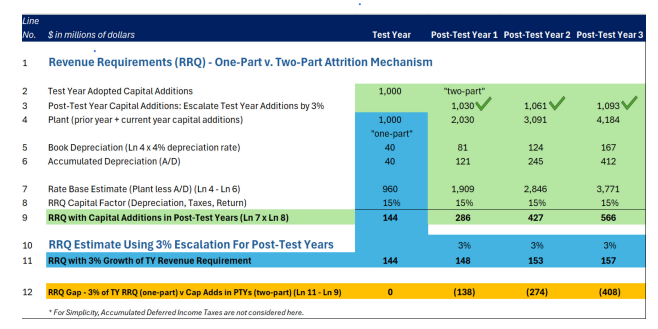
At issue: The Sempra Utilities claim the adopted attrition mechanism leaves approximately $5 billion in recurring capital projects inadequately funded during the 2025–2027 post-test-year period.
- During the meeting, the Sempra IOUs explained that the decision’s approved attrition mechanism (which applies a flat 3% annual escalation to the 2024 test-year revenue requirement) does not allow the utilities to recover the full depreciation or rate of return associated with their capital investments during the post-test-year period.
- The companies argued that this approach leads to significant under-recovery of capital costs as capital expenditures grow over time. To address this issue, the utilities are proposing a replacement of the current escalation method with a capital-additions attrition mechanism based on a seven-year average of historical and forecast capital spending, which they said is consistent with a Track 1 settlement between the utilities and Cal Advocates.
- The companies also noted that parties such as TURN/Southern California Generation Coalition and the Federal Executive Agencies had independently recommended a capital-additions mechanism based on a seven-year average in their respective Track 1 testimony.
INSTANT ANALYSIS: SoCalGas and SDG&E are pressing the CPUC to revise the attrition formula adopted in the 2024 GRC decision. They argue the current 3% escalation on the test-year revenue requirement does not track actual capital spending and leads to under-recovery of depreciation and return during 2025–2027.
The utilities want a capital-additions attrition method based on a seven-year capital average. If accepted, this approach would raise revenue recovery during the attrition period and better align rates with the timing of capital entering service. The presentation included illustrative tables showing that, for a project with a mid-year in-service date, the 3% mechanism produces a cumulative shortfall of $12.7 million against what a capital-additions approach would yield, and that over 70% of the companies' capital is recurring work, amplifying the gap across the full portfolio.
GAS SYSTEM RELIABILITY
PG&E submitted Advice Letter 5186-G to notify Energy Division that, on March 4, the company’s natural gas backbone transmission system fell below the minimum capacity standard required under prior Commission decisions governing gas system reliability.
The applicable standard requires utilities to maintain backbone transmission capacity sufficient to meet the average day demand in a “1-in-10 cold and dry year.” On that date, PG&E calculated total available capacity at 2,372 MMcf/day, which is 121 MMcf/day below the required threshold of 2,493 MMcf/day.
The shortfall is attributed to planned maintenance outages at Delevan Station and the Topock Compressor Station, scheduled from March 4 through March 6.
INSTANT ANALYSIS: The shortfall is modest and temporary. It does not indicate reliability problems or curtailments. The key point: post-2022 gas planning rules require utilities to formally report any day backbone capacity drops below the benchmark, even during routine maintenance.