WEDNESDAY AGGREGATE: PG&E and SCE Launch Flexible Service Connections, Allowing Large Loads to Interconnect Before Grid Upgrades
Today's briefing includes:
- Flexible Service Connections;
- IOU opposition to any non-zero valuation of pre-2019 banked RECs in the PCIA;
- A potential new compliance layer in the Climate Change Adaptation docket;
- Utility responses to the CPUC president on Senate Bill 884 matters; and
- PG&E's modified transmission service agreement with Microsoft.
FLEXIBLE SERVICE CONNECTIONS
PG&E and SCE jointly filed an advice letter implementing a February decision (D.26-02-025), which directed both utilities to establish a tariffed standard offering for Flexible Service Connections within 60 days. (See CRI's coverage of D.26-02-025 here).
 MC
MC
The framework lets eligible customers receive electric service before full infrastructure upgrades are complete by operating under predefined Power Import Limits and time-varying seasonal load profiles. Participation is voluntary, requires customer-installed, utility-approved control systems, and is explicitly framed as an interim bridge (the agreement terminates when upgrade capacity is restored).
Eligibility is determined by the utility based on grid and customer characteristics. Customers on circuits with pre-existing underground cable temperature exceedances are categorically ineligible. For eligible projects, utilities develop Load Limit Profiles optimized to the specific constrained component, monitor compliance through Advanced Metering Infrastructure and eventually DERMS, and may curtail or disconnect customers who exceed limits. The proposal standardizes the application process, engineering methodology, and cost-tracking requirements across both utilities.
INSTANT ANALYSIS: This filing creates a new access model for constrained distribution capacity. Rather than waiting for upgrades, loads with flexibility and the capital to deploy control systems can secure partial service now by accepting curtailment obligations, turning interconnection into a performance-based arrangement. That is a meaningful shift in how utilities manage distribution scarcity.
Near-term, the beneficiaries are controllable demand: data centers, fleet charging, and industrial loads with shift flexibility. Inflexible loads stay behind upgrade queues. Load flexibility is beginning to function as a prerequisite for timely grid access, not just a rate incentive.
Longer-term, utilities are building the contractual and monitoring infrastructure to condition grid access on real-time operational compliance. If upgrade backlogs grow faster than capital programs can clear them, this framework could graduate from a bridge mechanism into a permanent allocation regime, where dynamic limits replace guaranteed capacity as the baseline service expectation.
PCIA/ERRA REFORM
In a pair of April 2026 ex parte meetings, PG&E, SCE, and SDG&E briefed Commissioner Darcie Houck, President John Reynolds, and Commissioner Matthew Baker on their opposition to any non-zero valuation of pre-2019 banked Renewable Energy Credits in the Power Charge Indifference Adjustment.
- The investor-owned utilities want one outcome: zero-dollar valuation. They argue that a Track 2 proposal advanced by CalCCA would retroactively revalue legacy RECs, shift costs onto bundled customers to benefit a subset of departing load customers, and conflict with the Public Utilities Code. On the product side, they argue that pre-2019 RECs are non-tradable, lack energy attributes, and carry no power content label or Integrated Resource Planning value. In their view, applying the RPS Market Price Benchmark to those credits is a category error.
- The IOUs lean on CalCCA's own 2019 working group filing, reproduced in an appendix, where CalCCA stated that pre-2018 RECs were already paid for by bundled customers under prior RPS Adders. That becomes an estoppel line: the accounting was settled, the framework moved forward on that basis, and reopening it now is selective.
- For reference, CalCCA's March 5 ex parte frames the issue as a missing credit that arises when IOUs use banked RECs for current compliance. Under its proposal, later-departing customers receive value at the RPS Market Price Benchmark at the point of use, reflecting the IOUs' avoided cost of procuring replacement RECs. CalCCA ties this to Commission treatment of banked RECs in later vintages and presents it as a continuation of existing methodology, not a reset of prior accounting.
INSTANT ANALYSIS: This is a battle over when value is recognized. The IOUs anchor value at the time of payment and treat the accounting as closed. CalCCA anchors value at the time of use and treats the current framework as incomplete until that credit is applied.
The IOUs invoke the CPUC's 2021 Voluntary Accelerated Market Operations decision (D.21-05-030) to widen the blast radius, arguing it rested on existing treatment of banked RECs and that a shift now would call prior outcomes into question. That moves the dispute from valuation mechanics into decision integrity.
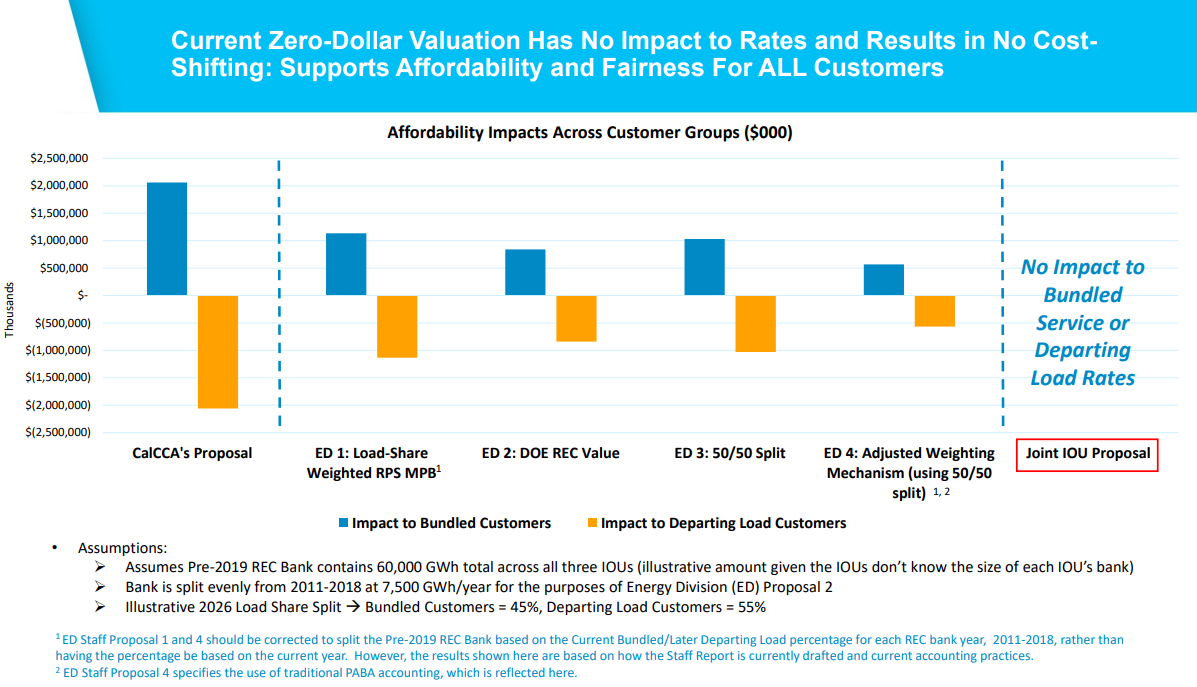
Every non-utility proposal in the IOUs' attached affordability chart (see below) generates a net cost transfer onto bundled customers: over two billion dollars under CalCCA's primary proposal, hundreds of millions to over one billion under the four Energy Division staff alternatives. If Energy Division drifts toward partial valuation, this becomes a negotiation over allocation mechanics. If staff holds near zero, CalCCA's position collapses.
CLIMATE CHANGE ADAPTATION
Commissioner Darcie Houck issued a ruling that moves climate adaptation out of long-cycle utility planning and into the application review process. The ruling solicits comment on a staff-proposed Climate Adaptation Framework that would require investor-owned utilities to address climate risks directly in infrastructure, maintenance, and emergency response filings. Initial comments are due April 30, with replies on May 15.
The CPUC's Safety Policy Division proposes a standardized structure organized around five policy areas: repetitive loss and failure, site selection, design and engineering, equipment tolerance, and climate risk modeling. For covered filings, utilities would screen against these areas, document climate risks and modeling assumptions, and tie project decisions back to existing planning tools:
- The Climate Adaptation Vulnerability Assessment; and
- Risk Assessment and Mitigation Phase.
Where that linkage is absent, utilities must explain why. An annual reporting requirement tracks how the framework was applied across filings over the prior year.
The framework is presented as guidance, not a requirement. The ruling asks whether it should become mandatory, what thresholds should govern applicability, and whether smaller utilities should face scaled or phased obligations. Those questions remain open.
INSTANT ANALYSIS: This structure would create a new compliance layer. Once utilities begin filing against these five areas, Energy Division reviews them, parties litigate them, and ALJs reference them in decisions. That is how CPUC guidance becomes practice. The near-term effect is more documentation, new intervenor entry points on modeling assumptions and design standards, and greater Commission discretion to shape project outcomes (before any formal mandate arrives).
UNDERGROUNDING
On April 10, the three major electric IOUs responded to prehearing conference instructions from CPUC President John Reynolds and ALJ DeAngelis. Reynolds made it clear that he was surprised, particularly in PG&E's case, that no IOU undergrounding plan had been filed with the Office of Energy Infrastructure Safety (Energy Safety). His expectation was that post-2027 undergrounding decisions should be made within the Senate Bill 884 framework, not in General Rate Case submissions.
All three utilities share a common defense: the framework has been too unstable to anchor final investment decisions. Beyond that, their positions are different.
- PG&E gives the most detailed account. Years of shifting guidance between the CPUC and Energy Safety repeatedly forced revisions to its 10-year Electrical Undergrounding Plan (Benefit-Cost Ratio methodology changes, revised data templates, new cost-recovery rules), with each iteration resetting work that was already done. With Resolution SPD-37 in effect, PG&E sees a viable path and is targeting a Q3 2026 filing, a 2028 program start, and interim continuity through a General Rate Case bridge program if approvals slip.
- SCE has not decided whether to file at all. Its existing General Rate Case already authorizes undergrounding through 2028, reducing immediate pressure to enter the new framework. It offers no filing timeline and is still evaluating whether SB 884 is even the right venue for post-2028 activity.
- SDG&E expressed a general intent to file before year-end 2026 while conditioning that on how the CPUC resolves open Phase 1 issues that could affect Benefit-Cost Ratio calculations. It is further along than Edison.
INSTANT ANALYSIS: The utilities are being asked to commit capital while Benefit-Cost Ratio math, audit rules, and cost-recovery conditions remain unsettled. Until Phase 1 of this proceeding closes, SB 884 remains a parallel track, not the primary decision venue that President Reynolds intends it to be.
LARGE LOADS/DATA CENTERS
PG&E filed an advice letter modifying its transmission service agreement with Microsoft for a 90 MW data center in San Jose, implementing two directives from Resolution E-5439:
- Extending the refund eligibility period from 10 to 15 years; and
- Capping annual refunds at 75% of transmission-related net revenues collected from the project, adjusted for Income Tax Component of Contribution.
The modified agreement also adds consequential damages and limitation of liability provisions to protect ratepayers. Key financial terms are confidential.
See CRI's coverage of Resolution E-5439 here.
MC
INSTANT ANALYSIS: This filing puts the CPUC's framework for hyperscale transmission load into practice: customized agreements, cost recovery tied to project-specific revenues, refund exposure capped and time-bounded. The contracts and deviations sheets show Google and STACK Infrastructure moving through the same Rule 15/16 pathway, confirming this is now a repeatable structure rather than a one-off accommodation. The terms are designed so utilities recover costs, ratepayers aren't exposed to project shortfalls, and large customers get transmission access without broad cost socialization. That balance is what makes these agreements approvable. This pattern should hold as hyperscale demand continues hitting PG&E's service territory.