MONDAY AGGREGATE: CPUC Scoping Memo Opens Fight Over PG&E Gas Cost Reallocation
Today's briefing includes:
- A scoping memo in the PG&E "CARD" proceeding;
- An upcoming Aliso Canyon workshop;
- SCE's wildfire cost recovery;
- SCE's 2025 ERRA compliance;
- PG&E's annual update on self-insurance programs; and
- PG&E's climate-adaptation initiatives.
PG&E NATURAL GAS RATES
Commissioner Christine Harada issued a scoping memo in A.25-11-006, establishing the framework for PG&E's proposed 2027–2030 gas cost-allocation and rate-design changes. For the first time, PG&E is combining its GCAP and GT&S cost-allocation and rate-design proposals into a single application.
The ruling scopes 21 issue areas covering:
- Rate forecasts;
- Cost-allocation methodologies;
- Storage procurement;
- Backbone rate design; and
- Customer class impacts.
The primary dispute is PG&E's proposed shift from marginal to embedded cost allocation. This change reallocates recovery across customer classes as throughput declines, increasing pressure on noncore and large-volume users. Storage reliance on independent providers and Independent Storage Provider ownership concentration are also explicitly scoped.
Intervenor testimony is due July 16; rebuttal is due August 26.
INSTANT ANALYSIS: Consolidating the GCAP and GT&S CARD into one proceeding concentrates risk for all parties. Intervenors must now engage across distribution, transmission, and storage simultaneously. The embedded cost shift is a throughput-driven reallocation framed as a methodology update. Add ISP concentration and storage dependency, and this looks like a long-term restructuring of who bears PG&E's stranded gas infrastructure costs.
ALISO CANYON WORKSHOP
SoCalGas has scheduled a virtual Aliso Canyon Biennial Assessment Workshop for April 15 (10:00 a.m. to 12:30 p.m.) in A.26-01-009, fulfilling a mandatory 90-day deadline under a 2024 decision (D.24-12-076), not a strategic choice.
At issue: Energy Division's 2025 Biennial Assessment recommends cutting Aliso Canyon's authorized inventory by 10 Bcf to 58.6 Bcf. SoCalGas is contesting the pipeline deliverability inputs, receipt-point utilization, and storage withdrawal curves that produced that number.
INSTANT ANALYSIS: SoCalGas isn't negotiating the size of the cut, it's attacking the analytical foundation that justifies any cut. April 15 is Round One. The downstream stakes are concrete: a 10 Bcf reduction triggers a corresponding cut to the Unbundled Storage Program, constraining noncore customer access to storage and increasing spot market exposure during peak events. If SoCalGas gains traction, Aliso Canyon remains a critical reliability asset through the late 2020s, a period in which the field's dispensability is conditioned entirely on infrastructure upgrades and demand declines that have not yet materialized.
WILDFIRES
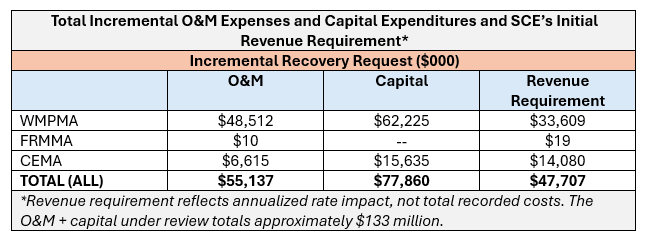
Commissioner Karen Douglas issued a scoping memo for SCE's A.25-12-002, where Edison seeks reasonableness findings on three buckets of wildfire mitigation and catastrophic event costs.
The headline figure ($47.7 million in initial revenue requirement as of September 30, 2025) understates the underlying request. The actual pool under review is $55.1 million in O&M and $77.9 million in capital across:
- Wildfire Mitigation Plan Memorandum Account and Fire Risk Mitigation Memorandum Account costs (primarily 2024 wildfire mitigation spending);
- Catastrophic Event Memorandum Account sub-accounts tied to four named fire events (the 2017 Rye, 2018 Holiday, 2020 Blue Ridge, and 2021 French fires); and
- $36.3 million in 2022 capital denied in a 2025 decision (D.25-06-051), recovery of which is contingent on a pending rehearing resolving in SCE's favor.
SCE's application also proposes a memorandum account to track jurisdictional cost shifts from FERC Order 898. Cal Advocates and TURN have protested the filing.
Intervenor testimony is due June 23, with rebuttal testimony served by July 17. Opening briefs are due August 31, with reply briefs due September 8.
INSTANT ANALYSIS: The $47.7 million revenue requirement is the rate impact number. The proceeding is actually about a much larger pool of O&M and capital costs and whether SCE retains the discretion to convert them into customer recovery over time.
SCE already absorbed a $10 million shareholder haircut under the Thomas Fire settlement before filing this. What remains is still contested, particularly the 2022 capital, which isn't a routine true-up but a second attempt at costs the Commission already declined to approve. If the rehearing fails, that piece falls away entirely.
The FERC angle is small but worth tracking. As cost categories migrate between CPUC and FERC jurisdiction, who pays and on what timeline shifts with them.
ERRA COMPLIANCE
SCE filed its 2025 ERRA compliance application, seeking CPUC verification that its fuel and purchased power costs, contract administration, generation dispatch, and spot market transactions complied with its approved procurement plan for the January–December 2025 record period.
Most balancing accounts are subject to after-the-fact audit rather than reasonableness review. SCE's fourteen memorandum accounts require explicit approval and carry a net $11.531 million undercollection that SCE wants transferred into rates.
Bill impact is de minimis (about $0.10/month for a typical residential customer). Protests are due May 6.
INSTANT ANALYSIS: SCE's request is small enough to discourage direct opposition, but the ERRA is where procurement behavior gets scrutinized and records get built. The real exposure is SCE's least-cost dispatch, gas procurement, GHG instrument strategy, and CAISO cost treatment, not the $11.5 million. If any of those get challenged successfully, this application moves from a mundane bookkeeping exercise to a prudence fight with downstream consequences.
UTILITY SELF-INSURANCE
PG&E's Advice Letter 7880-E provides an annual update on wildfire and non-wildfire self-insurance programs, including prior-year activity and 2026 revenue requirements. Wildfire claims in 2025 totaled approximately $50,000, producing no change to the 2026 revenue requirement.
The self-insurance fund (built primarily from CPUC ratepayers in 2023 and FERC transmission customers in 2024–2025) generated approximately $40 million in net investment income last year and is projected to reach $1.036 billion by year-end 2026. PG&E also plans to refund about $38 million in excess FERC collections in December 2026.
For non-wildfire liability, PG&E's hybrid insurance structure shifts Layer 2 coverage ($75 million to $535 million) to self-insurance. With zero recorded non-wildfire claims in 2025, PG&E proposes no 2026 revenue requirement adjustment while continuing to collect $96 million from CPUC customers to build toward a $460 million fund target.
INSTANT ANALYSIS: PG&E's wildfire reserve is now in surplus. With negligible 2025 claims and a fund tracking above $1 billion, near-term rate pressure is absent; attention shifts to the $38 million FERC refund and how long excess balances persist before triggering return obligations.
The non-wildfire program remains in buildout. Ratepayers are funding forward risk capacity against zero realized losses while PG&E accelerates accumulation toward the $460 million target.
The deeper concern is capital governance. Large utility-controlled reserves are growing inside captive entities with limited oversight friction (this filing carries a Tier 2 designation requiring no CPUC resolution) while PG&E has self-directed a request to retain balances above $1 billion indefinitely. That is the issue worth watching: not today's rates, but tomorrow's refund, earnings treatment, and regulatory scrutiny once reserves substantially exceed modeled risk.
CLIMATE ADAPTATION
PG&E filed Advice Letter 5193-G/7874-E, its annual compliance update under a 2020 CPUC decision (D.20-08-046), identifying the current composition and reporting structure of its Climate Resilience Team and summarizing activities from the past year. No new policy or cost recovery is proposed.
Over the past year, PG&E advanced several workstreams:
- Updated electric engineering design standards using climate projections;
- Hourly climate load forecasting inputs drawn from the State's Fifth Climate Assessment; and
- Pilot projects embedding forward-looking climate data into asset failure and debris flow risk models.
PG&E also participated in the CPUC's Climate Adaptation workshops and working groups throughout 2025 and is developing its 2027 Climate Adaptation Vulnerability Assessment under the updated framework established by a 2024 decision (D.24-08-005).
INSTANT ANALYSIS: The load forecasting and asset risk model work is the thread to watch. Climate projections embedded now into planning inputs will surface later as demand forecast assumptions in General Rate Cases and risk justifications in wildfire mitigation cost narratives. The 2027 Climate Adaptation Vulnerability Assessment, shaped by D.24-08-005's revised methodology, is the vehicle through which those assumptions will acquire cost recovery rationale. This filing is the early administrative layer of that longer sequence.