FRIDAY AGGREGATE: Aliso Canyon Goes Procedural; CPUC May Keep PG&E Wildfire Costs on Track
Today's briefing covers:
- The continuing Aliso Canyon saga;
- PG&E's Wildfire & Gas Safety application;
- SoCalGas's upcoming customer forum;
- Backbone gas transmission adequacy;
- Nuclear decommissioning; and
- Utility safety reportage.
ALISO CANYON INVENTORY LEVELS
On April 15, we reported on the Aliso Canyon workshop that convened that day. Since then, SoCalGas has filed workshop presentations on behalf of itself and the CPUC's Energy Division.
At issue: Energy Division's 2025 Biennial Assessment recommends cutting Aliso Canyon's authorized inventory by 10 Bcf to 58.6 Bcf. SoCalGas is contesting the pipeline deliverability inputs, Receipt Point Utilization, and storage withdrawal curves that produced that number. The relevant proceeding is A.26-01-009.
 MC
MC
SoCalGas disputes Energy Division's analytical foundation, which evaluates natural gas storage needs through four analyses:
- Demand reduction;
- Gas balance reliability;
- Hydraulic modeling; and
- Economics.
SoCalGas argues that Staff's Biennial Assessment systematically overstates available pipeline supply by assuming Receipt Point Utilization levels that do not reflect real storm conditions. Historical events support that argument: Winter Storm Fern in January 2026 reduced Receipt Point Utilization to 25%, the 2024 Arctic Blast to 38%, and the 2021 event to 47%.
NEXT STEPS: Parties may submit comments on workshop presentation slides by April 28, with reply comments due May 5. Parties may also propose modifications or additional analysis to inform the next biennial assessment cycle.
An April 16 email ruling from ALJ Ormond directs SoCalGas to compile historical outage information. Outages outside its service territory over the past decade are due by May 1, while outages within its territory over the same period are due by May 15, with the option to include older events. Parties may comment on these outage reports by June 1.
Additional CRI coverage of Aliso Canyon inventory levels is available at the following links.
MC MC
MC MC
MC
ALISO CANYON – ADDITIONAL ISSUES (DISCOVERY & PROCEDURE)
SoCalGas filed a response on April 16 urging the CPUC to deny a Sierra Club motion to compel additional discovery in A.26-01-009. SoCalGas argues the disputed requests (bulk production of discovery records from two prior dockets and a historical accounting of gas-price mitigation measures) are irrelevant to a proceeding whose sole purpose is evaluating future Aliso Canyon inventory levels.
The strongest argument in the filing is procedural: no scoping memo has been issued. The CPUC has not formally defined the issues for this proceeding. Sierra Club is demanding wholesale discovery against a target that doesn't yet exist, and SoCalGas says that alone forecloses any showing of relevance.
INSTANT ANALYSIS: The no-scoping-memo argument is a threshold kill shot: if the ALJ agrees with SoCalGas, Sierra Club's motion fails before the merits are reached. No defined issues means no cognizable relevance standard means no compelled production. SoCalGas's good-faith compromise offers during meet-and-confer (targeted production on discrete issues, rejected same day) reinforce this stance. Watch for the ALJ's ruling on this dispute: it will show how much latitude intervenors have to import prior-proceeding record into forward-looking gas infrastructure cases before the proceeding is even scoped.
WILDFIRE MITIGATION & GAS SAFETY
The CPUC issued an amended scoping memo in PG&E's Wildfire Mitigation and Gas Safety cost-recovery proceeding (A.23-06-008). The ruling reopens the record to admit new evidence on 2023–2030 revenue requirements and removes specific dollar amounts from the scoped issues. The point of doing this is to allow broader consideration of how approved costs translate into rates.
The underlying problem is procedural: costs that are already under review lack a recovery forum for later years because General Rate Case cycles didn't align with this case's timeline. The ruling directs parties to meet and confer on whether additional testimony or hearings are needed, with a joint status report due May 13.
INSTANT ANALYSIS: Once costs clear prudency review here, the downstream revenue requirement follows. The CPUC will adjust the procedural vehicle rather than let recovery strand. For PG&E, billions in wildfire and safety spending stays on a viable recovery path into the next decade. For intervenors, litigation risk re-enters late, now focused on how costs translate into rates, not just whether they were prudently incurred.
SOCALGAS ANNUAL CUSTOMER FORUM
SoCalGas will hold its annual Utility Customer Forum on May 15, as a virtual webinar, with RSVPs due by May 14. The forum will review:
- How Operational Flow Order events are triggered;
- How the Operational Hub acquires and deploys gas supplies to maintain minimum flow requirements; and
- Whether additional flow requirements, tools, or infrastructure improvements are needed to support system reliability.
Ahead of the meeting, SoCalGas will publish an annual report by May 1 summarizing reliability issues, minimum flow needs, and operational activity, including transaction-level detail.
BACKBONE GAS TRANSMISSION
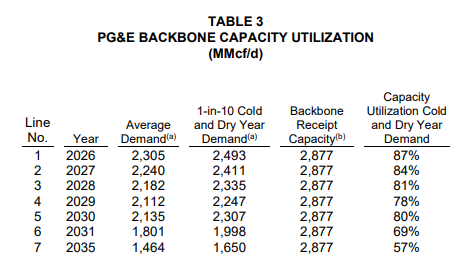
On April 15, PG&E and SoCalGas submitted compliance filings demonstrating their backbone gas transmission adequacy. A key regulatory shift: utilities now report actual operating capacity against the 1-in-10 cold-and-dry year design standard, not nominal capacity.
- PG&E's combined backbone capacity remained sufficient through March 31, 2026 and is projected to meet demand through 2035. One documented exception: gas day 03/04/2026, when simultaneous maintenance at Delevan Station and Topock Compressor Station produced a 121 MMcfd deficit against the 2,554 MMcfd threshold, the only below-standard day in the period.
- SoCalGas exceeded minimum design standards on every day of its nine-month compliance window and projects reserve margins ranging from 64% in 2026 to 83% in 2035.
PG&E Advice Letter 5201-G; SoCalGas AL 6629-G (available here).
INSTANT ANALYSIS: These filings confirm surplus conditions on the intrastate gas system at the moment policy momentum is pointed the other direction. Both utilities are telling the CPUC the same thing: backbone capacity is not constrained, reliability standards are being met with margin, no near-term infrastructure shortfall is emerging. That undermines any immediate reliability-based case for new gas investment while reaffirming that existing assets can carry the system through the transition window.
The shift to actual operating capacity reporting gives the CPUC a firmer evidentiary grip on real system performance: a cleaner baseline for future policy moves, whether that means ratcheting down capacity requirements, or litigating cost allocation as load declines.
One number worth watching: PG&E's Table 3 shows utilization dropping from 87% in 2026 to 57% by 2035, with off-system contracts going to zero after 2030. The 80-90% utilization guideline was written for a different system.
NUCLEAR DECOMMISSIONING
PG&E filed two parallel advice letters on April 16 requesting CPUC authorization to draw from nuclear decommissioning trusts for 2026 (AL 7889-E and AL 7893-E). The filings share a regulatory framework but reflect opposite situations.
- Diablo Canyon: PG&E requests $3.4 million against a $4.3 million 2026 plan. The 2021 cost estimate projected $519 million for 2026 activities. The gap is Senate Bill 846, the 2022 legislation extending operations to 2030 suspended the active decommissioning program, leaving only permitting, transition planning, and spent fuel preparation. The $5 billion trust is intact. The decommissioning project is not.
- Humboldt Bay Unit 3: PG&E requests $12.1 million against a $13.4 million 2026 plan, entirely for spent fuel management (Independent Spent Fuel Storage Operations, security staffing, and Nuclear Regulatory Commission fees). The decommissioning itself is done; the Part 50 license was terminated in November 2021. What remains is a spent fuel custody problem running to 2033, pending DOE pickup currently forecast for 2031–2032.
INSTANT ANALYSIS: These filings share a common endpoint: long-term on-site fuel storage awaiting federal removal. Humboldt Bay is the cleaner case. Decommissioning is complete, the license terminated in 2021, but the site remains active because DOE pickup isn't forecast until 2031–2032. The Independent Spent Fuel Storage Operations run to 2033. Diablo Canyon extends the timeline but not the destination. Senate Bill 846 bought the state a few more years of generation and deferred the decommissioning program by a decade. The back-end obligation remains. Ratepayer-backed trusts are funding an indefinite holding pattern on federally stranded material.
UTILITY SAFETY CULTURE
SoCalGas's Q1 2026 Safety Culture Improvement Plan report updates the CPUC on progress under I.19-06-014, an investigation into whether SoCalGas and its parent Sempra had organizational cultures and governance structures that genuinely prioritized safety. The impetus was the 2015 Aliso Canyon gas storage blowout.
SoCalGas's report documents implementation under a "Plan-Do-Check-Act" framework, with the stated goal of shifting safety culture from compliance-oriented incident avoidance toward a learning-driven model embedded in leadership behavior and daily operations.
INSTANT ANALYSIS: SoCalGas is building a compliance-grade safety culture. Whether it holds depends on field-level behavior change, not internal coherence.