WEDNESDAY AGGREGATE: SoCalGas TIMPBA; Sempra IOUs' Corporate Restructuring; CCA Challenge to PCIA Methodology
Today's briefing covers:
- A prudence dispute over SoCalGas's $174 million TIMP recovery request;
- A scoping memo on Sempra's proposed intermediate holding company;
- A CCA challenge to retroactive PCIA methodology;
- SDG&E's loss-of-load analysis supporting its current critical peak pricing window; and
- A FERC-approved transmission credit flowing back to San Diego ratepayers.
If reports like this have been useful for you (or your team), please consider becoming a paid subscriber in 2026. Our Founder's Rate is available until January 13 and locks members in at that price permanently ($225/month or $2,250/year). Team and enterprise packages are also available; contact us for assistance.
Natural Gas Transmission Integrity
SoCalGas’s application to recover $173.8 million in costs recorded in its Transmission Integrity Management Program Balancing Account (TIMPBA) has developed into a dispute over prudence, affordability, and evidentiary sufficiency.
SoCalGas's request covers TIMP expenditures above a 135% cap authorized in its Test Year 2019 General Rate Case (and previously approved through Resolution G-3600), placing the burden on SoCalGas to demonstrate that both the level and timing of the additional spending were reasonable. Intervenors argue that this burden has not been met, while SoCalGas maintains that the costs were mandatory, compliance-driven, and supported by the record.
In reply briefs, the Indicated Shippers and Cal Advocates each contest SoCalGas’s position that federal pipeline safety requirements justify the magnitude and pace of the spending. They argue that compliance obligations do not eliminate the utility’s responsibility to manage costs prudently, particularly in light of ratepayer affordability concerns and CPUC efforts to manage gas system costs during the transition away from fossil gas.
Below are links to parties' reply briefs. (See our summary of parties' opening briefs here.)
INSTANT ANALYSIS: The dispute here is not about whether TIMP work was required, but whether SoCalGas exercised cost discipline in how it was timed, scoped, and recovered. Intervenors are pressing a narrow theory: compliance does not excuse acceleration, weak documentation, or labor costs that may already be in base rates. The proposed 12-month recovery window is emerging as a flashpoint, with rate shock framed as a prudence failure, not a secondary issue. The outcome will hinge on what the CPUC treats as sufficient proof of prudence.
Sempra IOUs' Corporate Restructuring
The assigned commissioner (Karen Douglas) issued a scoping memo in A.25-05-020, which concerns SoCalGas/SDG&E's request for approval of a corporate restructuring involving the creation of an intermediate holding company, "Sempra California, LLC."
The application seeks either an exemption under the Public Utilities Code, or, in the alternative, a determination that the transaction does not trigger PU Code Section 854 review. (PU Code Section 854 is the CPUC’s gatekeeping statute for utility control transactions; it is meant to ensure that corporate reorganizations or ownership changes do not undermine regulatory protections or shift risk onto customers.)
The scoping memo confirms that the proceeding will examine whether:
- Section 854 applies to the proposed holding-company formation;
- An exemption is warranted if it does apply;
- The transaction is in the public interest with adequate safeguards for ratepayers and Commission oversight; and
- There are social and environmental impacts.
INSTANT ANALYSIS: This scoping memo confirms that the holding-company restructuring will proceed without evidentiary hearings; the ruling treats the matter as a legal and policy determination rather than a factual dispute. The CPUC’s focus is whether the creation of an intermediate holding company triggers Section 854 and, if so, whether existing regulatory safeguards adequately protect ratepayers and preserve oversight. A final decision on this matter will set precedent on the reach of CPUC jurisdiction into upstream corporate reorganizations.
SDG&E Rates/Market Price Benchmark
San Diego Community Power and Clean Energy Alliance (the SD CCAs) filed an application for rehearing of a 2025 CPUC decision (D.25-12-008), arguing that the CPUC unlawfully set Power Charge Indifference Adjustment rates by retroactively applying a new Resource Adequacy Market Price Benchmark methodology to 2025 costs. (See our coverage of D.25-12-008 here.)
The filing contends that SDG&E had already collected 2025 PCIA rates based on the prior, Commission-approved Market Price Benchmark methodology, and that the Commission’s subsequent change in D.25-06-049 (when carried through into D.25-12-008) amounts to prohibited retroactive ratemaking rather than a permissible true-up.
According to applicants, this approach exceeds the Commission’s authority, violates the Public Utilities Code, lacks adequate findings and evidentiary support, and produces significant, unjustified cost impacts on unbundled customers. The application asks the Commission to grant rehearing and hold a consolidated oral argument alongside related rehearing requests in other ERRA forecast proceedings.
INSTANT ANALYSIS: This rehearing application is a direct challenge to the CPUC’s use of a revised RA Market Price Benchmark to re-price 2025 PCIA costs, with CCAs arguing the Commission crossed a clear legal boundary by applying a new methodology to costs already collected. If the Commission retreats here (or the courts later intervene), the decision could constrain how PCIA true-ups are handled and limit the CPUC’s ability to reallocate above-market costs onto departed load in future proceedings.
Rate Design/Critical Peak Pricing
SDG&E filed Advice Letter 4781-E (available here) to update its critical event period based on a loss-of-load analysis of its local capacity areas.
- Using a stochastic Loss of Load Expectation analysis modeled in PLEXOS and incorporating projected 2026 resources, SDG&E evaluated the San Diego Greater Reliability Area and the San Diego sub-area to identify hours with the highest likelihood of capacity shortfalls.
- The results show that loss-of-load risk remains concentrated in the evening hours, with the highest relative risk occurring between 4 p.m. and 10 p.m., consistent with prior years’ findings and reflecting ongoing solar and battery penetration shifting peak risk later in the day.
Based on this analysis, SDG&E concludes that its existing Critical Peak Pricing event window of 4 p.m. to 9 p.m. remains valid and supported by system conditions. Protests are due January 20.
| Current Hours & Analysis Results | Hours |
|---|---|
| December 2018 LOLE Analysis | 4–9 pm |
| December 2019 LOLE Analysis | 6–11 pm |
| December 2020 LOLE Analysis | 5–10 pm |
| December 2021 LOLE Analysis | 4–9 pm |
| December 2022 LOLE Analysis | 4–9 pm |
| December 2023 LOLE Analysis | 5–10 pm |
| December 2024 LOLE Analysis | 4–9 pm |
| December 2025 LOLE Analysis | 4–10 pm |
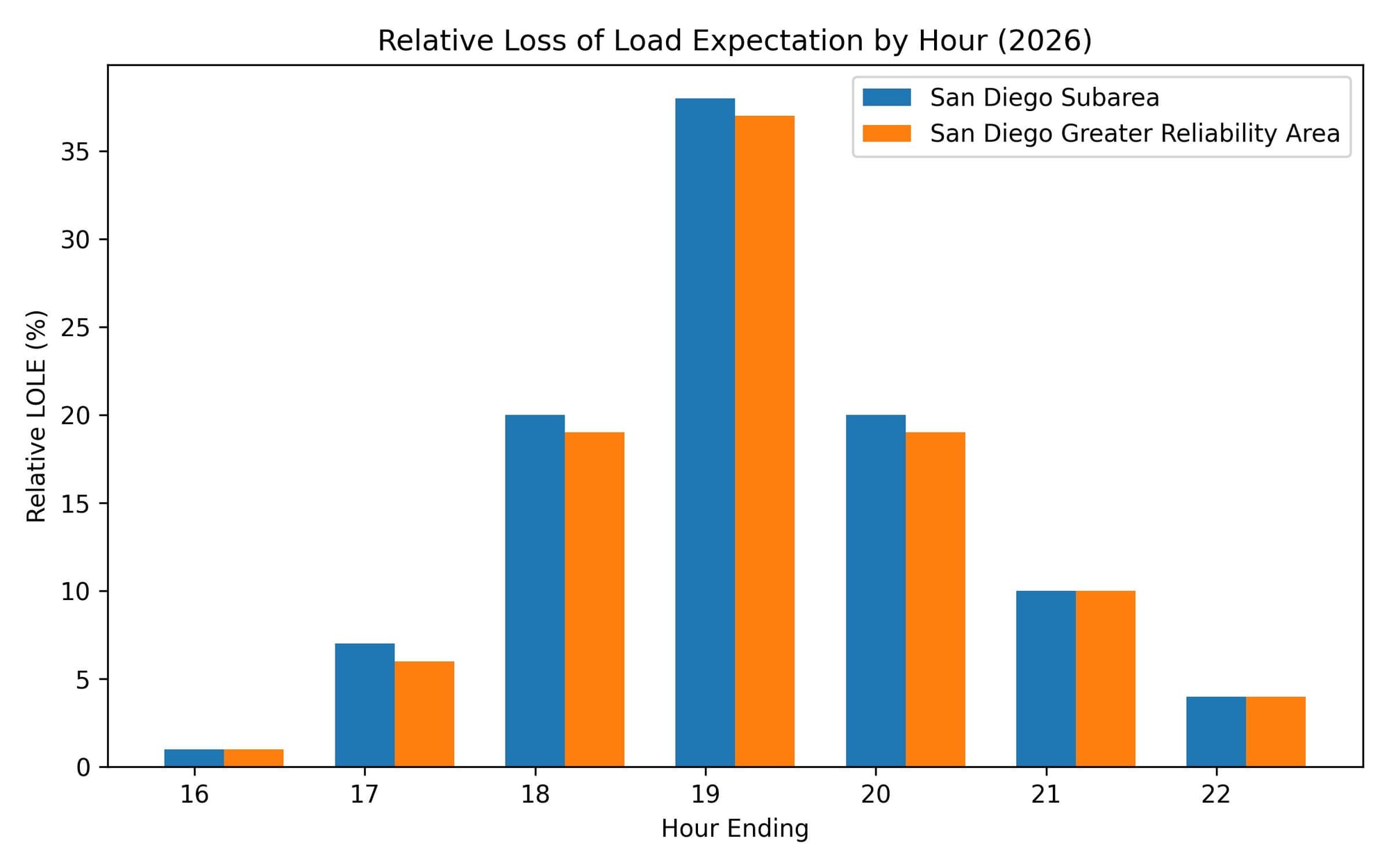
INSTANT ANALYSIS: SDG&E’s Loss of Load Expectation results continue to show evening-hour reliability risk extending to 10 pm, but the utility argues that the densest portion of that risk remains within the existing 4 p.m. –9 p.m. Critical Peak Pricing window. The filing implicitly highlights a growing mismatch between reliability physics and the behavioral limits of demand-side rate design (a gap that may widen as solar penetration increases).
Transmission Rates
SDG&E filed Advice Letter 4783-E (available here) to notify the CPUC that the Federal Energy Regulatory Commission has approved SDG&E’s annual update to its Transmission Access Charge Balancing Account Adjustment (TACBAA) rates. The filing explains that FERC approved SDG&E’s November 2025 TACBAA update on December 31, 2025, with rates effective January 1, 2026.
The TACBAA mechanism reconciles differences between the transmission costs SDG&E pays as a load-serving entity and the revenues it receives as a participating transmission owner under the CAISO tariff, with any net difference flowed through to retail end-use customers.
For 2026, the FERC-approved update results in an approximate $165.8 million revenue credit to retail customers, which SDG&E implemented in rates beginning January 1, 2026.
INSTANT ANALYSIS: This filing highlights transmission true-ups as a real swing factor in retail rates. FERC’s approval of SDG&E’s 2026 TACBAA update delivers an approximately $166 million credit to retail customers, showing how CAISO transmission cost reconciliation can temporarily offset other upward delivery-rate pressures, even as underlying cost trends continue to move higher.