RESOURCE ADEQUACY: The Assumptions Behind the 2028 LOLE Study (R.25-10-003)
The CPUC issued a ruling in the Resource Adequacy docket that attaches Energy Division's "Revised Inputs & Assumptions" for the 2028 Loss of Load Expectation Study.
This document establishes the modeling inputs and assumptions for the 2028 LOLE study, which has not yet been conducted. Integrated Resource Planning stakeholders will continue using the February 2026 inputs for the remaining analytical work in the 2024-2026 IRP cycle under the Joint Agency Single Forecast Set agreement.
MODEL & DATA VINTAGE
Staff deployed SERVM 10.28 and expanded the weather and hydro record to 2000-2024. California demand moves to the California Energy Commission 2025 Integrated Energy Policy Report Planning Scenario without known loads, non-CAISO resources are refreshed from the 2034 Western Electricity Coordinating Council Anchor Data Set, and all costs shift to 2024 real dollars. Staff also added ambient-temperature derates for thermal units. Unlike IRP modeling, the RA study uses Net Dependable Capacity for unit maximum output rather than the monthly Net Qualifying Capacity cap.
LOAD
Staff decomposes the 2025 IEPR managed forecast into consumption and demand modifiers (EV charging, transportation electrification, building electrification, behind-the-meter PV and storage, energy efficiency, climate adjustment, and data centers) grossed up for T&D losses to model demand at the generator busbar. Staff calibrates to the IEPR 1-in-2 consumption forecast rather than managed demand, which leaves SERVM's 2028 managed peak 1,032 MW above the IEPR figure: 49,388 MW versus 48,356 MW.
BASELINE RESOURCES
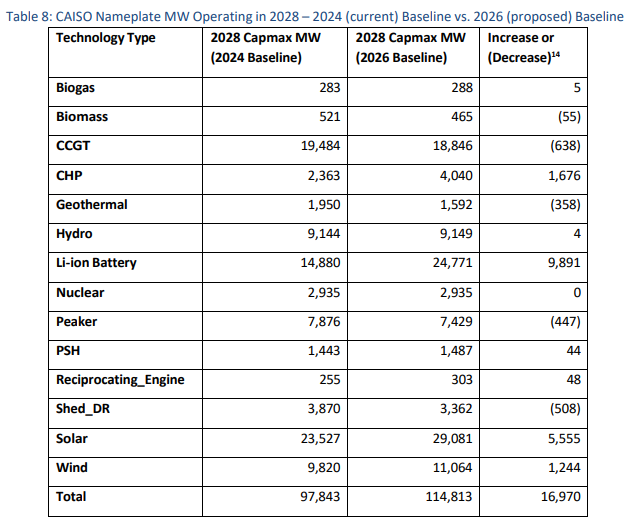
The 2028 CAISO baseline grows from 97,843 MW to 114,813 MW, a net gain of 16,970 MW, driven by batteries at 9,891 MW, solar at 5,555 MW, and wind at 1,244 MW. Combined Heat & Power rises 1,676 MW partly because staff reclassified units previously coded as combined cycle gas turbine or peakers. Demand response capacity falls 508 MW following the CPUC's discontinuation of the Demand Response Auction Mechanism programs. Diablo Canyon is in the RA baseline through its extended operating dates while IRP modeling continues to use the original retirement schedule.
OPERATIONS & PROFILES
The study retains an 11,040 MW maximum available import cap alongside a 4,000 MW peak-hours cap from 5 p.m. to 10 p.m., with three-hour ramping between the two, applied in all months. Hydro modeling uses the full 25-year record with separate run-of-river and scheduled-hydro treatment for PG&E and SCE. Natural gas inputs use the CEC North American Market Gas-Trade Model mid scenario.
RA MODELING
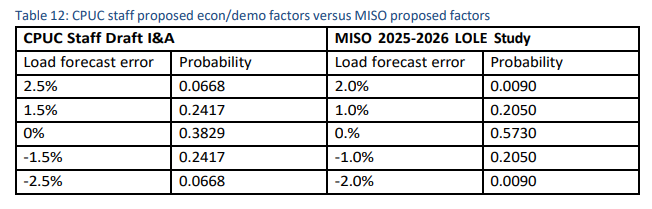
SERVM tests whether CAISO meets the 0.1 days/year LOLE standard and calculates Total Reliability Need in perfect-capacity terms. In response to SCE and CalCCA concerns, staff will run a MISO-style load-uncertainty sensitivity alongside the existing CPUC distribution. LOLE concentrates in June through September via the prior cycle's stress-test method, and if the system proves over-reliable, staff will test three methods in the following order:
- Adding perfect demand;
- Reducing capacity pro rata across all technology types; and
- Lowering the simultaneous import limit.
Final results include both UCAP-derated and non-UCAP-derated Planning Reserve Margin values.
EMISSIONS
Unspecified imports are assigned CARB's default emissions rate of 0.428 metric tons/MWh, while 8.31% of Northwest hydro is designated as a GHG-free specified import exempt from hurdle rates and emissions charges. Behind-the-meter CHP emissions are estimated from the 2025 IEPR forecast and added to modeled dispatch emissions to align with CARB electric-sector accounting.
INSTANT ANALYSIS
This filing establishes the assumptions that will produce the first major reliability determination in this proceeding, with the LOLE study expected by August 2026. The baseline expansion makes over-reliability a plausible starting point: the 2028 CAISO baseline is nearly 17 GW larger than the prior version, led by approximately 10 GW of batteries and 5.5 GW of solar. That makes staff's stress-test methodology choices consequential. Adding perfect demand, reducing capacity pro rata, and lowering the import limit affect different resource classes and load-serving entities differently, and the document does not indicate which approach staff will prioritize.
The load assumptions remain contested. The 1,032 MW gap between SERVM's modeled 2028 managed peak and the IEPR projection is a direct product of staff's decision to calibrate to consumption rather than managed demand. Staff also agreed to run a narrower MISO-style load-uncertainty sensitivity, but the base case still uses the wider CPUC distribution. If the sensitivity produces a meaningfully different Planning Reserve Margin, parties will dispute which result should govern.
External-region treatment may shift the result as much as the CAISO resource stack. Running both an as-is Anchor Data Set case and a calibrated-to-0.1-LOLE case will show how much California's modeled reliability depends on assumed surplus from neighboring regions, particularly a Pacific Northwest that may itself be resource-short. Diablo Canyon adds a separate mismatch: it's counted in the 2028 RA baseline but excluded from IRP modeling, meaning any RA determination premised on its presence will need revisiting as the extended operating dates approach.