WEDNESDAY AGGREGATE: SoCalGas BTS 2026 — Capacity Scarcity and Price Risk Without an Exit
Today's briefing is a microcosm of a gas system that is being redefined across infrastructure access and funding eligibility. SoCalGas is pushing more risk onto shippers competing for limited transport capacity, while the CPUC is narrowing the scope of ratepayer-funded gas innovation in PG&E’s RD&D program.
The result is a more selective system: access leans on historical position, and future pathways (transport and technology) face higher bars for entry and cost recovery.
BACKBONE TRANSPORTATION SERVICE
On March 31, SoCalGas held a webinar on Backbone Transportation Service (BTS) for shippers and noncore customers in advance of the 2026 Open Season. BTS provides firm and interruptible access to the integrated SoCalGas and SDG&E natural gas transmission system.
The Open Season is a three-step process (plus a re-contracting phase) through which eligible participants bid for that capacity, with different eligibility rules, bid types, and priority structures at each stage.
- Step 1 reserves set-aside capacity for core-related and legacy rights holders;
- Step 2 allows broader participation (noncore customers and marketers) with both baseload and monthly bids based on historical usage; and
- Step 3 opens remaining capacity to any creditworthy party, with contract terms ranging from 3 years, 1 month up to 20 years. Bidders cannot access years 4–20 if capacity is unavailable in years 1–3.
Capacity awards are prorated when oversubscribed, with baseload bids prioritized over monthly bids, and are subject to system constraints and maintenance outages that can reduce available volumes or trigger reallocations.
For 2026, SoCalGas is offering approximately 3,195 MMcfd across major zones (Northern, Southern, Wheeler Ridge, Coastal, and Line 85), contingent on maintenance conditions.
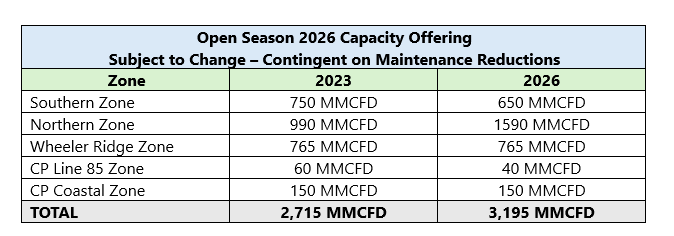
The Open Season timeline runs from June 2026 through September 2026. Key structural changes this cycle include a one-time 37-month initial term to align future cycles to November 1, a return to Modified Fixed Variable rate design for BTS2, and the introduction of a new BTS5 volumetric option.
After the auction, awarded capacity can be traded or reassigned via SoCalGas's Envoy platform, subject to a resale cap of 125% of the applicable G-BTS1/BTS2 reservation rate, with G-BTS5 resale capped at zero. Participants remain contractually obligated for awarded rights, rates float with future CPUC-approved tariff changes rather than locking in at award, and capacity generally cannot be returned prior to contract expiration.
INSTANT ANALYSIS: SoCalGas is rebalancing access to constrained receipt points under tightening system conditions. Prorated awards, baseload priority, and maintenance-driven derates mean participants are competing for an increasingly uncertain slice of firm deliverability, especially in zones like Topock and the Southern system, where reductions are already embedded. Historical usage is doing more than setting bidding rights; it is increasingly dictating who can reliably secure capacity at all.
The rate-design shifts and new BTS5 option add another layer. Moving BTS2 back to Modified Fixed Variable and introducing a volumetric pathway creates optionality, but also forces participants to make directional bets on load shape and utilization before the contract term begins.
More consequentially, rates float with future CPUC decisions while capacity commitments are binding, meaning shippers absorb regulatory cost risk after they've locked in transport obligations they cannot exit. The zero-cent G-BTS5 resale cap compounds this: holders of volumetric capacity have no secondary market exit at all.
NATURAL GAS RESEARCH
PG&E resubmitted its 2024 and 2025 Gas Research, Development & Demonstration plans as directed by Resolution G-3618, which denied PG&E's original filings but preserved a path to approval.
- The revised plans reduce the combined RD&D budget from $16.4 million to $8.6 million, including a steep cut in 2024 funding from approximately $8.1 million to $1.9 million.
- Hydrogen-related research has been largely removed from the 2024 plan and eliminated entirely from the 2025 plan, citing unresolved guidance on ratepayer funding roles and potential duplication with ARCHES and hydrogen blending pilots.
- The filing removes or narrows activities in emissions measurement, integrity management, and mandate-driven compliance work (Natural Gas Leak Abatement best practices, the PHMSA Mega Rule, CalGEM underground storage obligations). The Commission's position here is that ratepayer-funded research cannot claim benefit attribution for outcomes required by law.
- Out-of-state projects have been removed from the 2025 plan except where affiliated with a federal laboratory. Consortia participation has been reclassified from RD&D expenditure to Program Administrative activity and placed within the applicable administrative cost cap.
Benefit calculations have been strengthened using the EPIC Uniform Benefits framework, translating RD&D outputs into quantified, annualized ratepayer value. The initiative structure in the 2025 plan has been reorganized from six initiatives across two themes to three:
- Innovative and Cost-Effective Integrity Management;
- Advanced Leak Detection and Repair; and
- Clean Fuels Integration
INSTANT ANALYSIS: This filing is a capitulation document. The CPUC used Resolution G-3618 as more than a denial tool. It forced PG&E to self-apply eligibility standards the Commission had not fully codified — even as PG&E sought rehearing of G-3618's retroactive denial of $7.2 million in 2023-2024 costs.
The hydrogen retreat is the most significant signal: PG&E couldn't secure Commission buy-in on the ratepayer funding rationale and stripped it rather than fight, reflecting a deeper unresolved question about hydrogen's role in the gas system that the CPUC has declined to answer.
The budget math confirms the diagnosis. The 2024 cut is 76% while 2025 drops only 19%, meaning the 2024 plan was heavily loaded with exactly the categories that got stripped. The consortia reclassification looks like an accounting adjustment but limits how much PG&E can spend on industry coordination without eating into its administrative ceiling, a real operational constraint dressed as a compliance fix.
BIOMETHANE
Last week, we reported on parties' comments addressing a proposed decision that restructures the Renewable Gas Standard (which is on the agenda for the Commission's April 9 voting meeting). Since our briefing, multiple other parties' comments have surfaced in the CPUC's document feed. Our post has been updated accordingly. Note also that parties' reply comments are being filed today (April 1).