TUESDAY BRIEFING: UC Berkeley Report Targets IOU Earnings, Plus a July 1 BTS Rate Decrease
Today's briefing looks at a UC-Berkeley policy report, informed by many familiar names in the California energy sector e.g., Severin Borenstein, Matthew Freedman, Martha Guzman Aceves, Cliff Rechtschaffen, Matt Vespa, and Michael Wara. The report identifies barriers to California realizing its energy vision, with recommendations on how to proceed amidst the current affordability crisis.
Additionally, today's briefing examines a July 1 rate decrease for SoCalGas BTS customers plus the utilities' semiannual Independent Evaluator reports on third-party energy efficiency solicitations.
Separately, CRI would like to say thank you to all readers for your support, and particularly the recent wave of new paid subscribers. Your patronage is greatly appreciated and keeps the machine running. Please reach out at any time with questions, concerns or recommendations.
-- MC
AFFORDABILITY
A new policy report from UC-Berkeley's Center for Law, Energy & the Environment (CLEE) frames California's electricity affordability crisis as a governance failure more than a clean-energy cost problem.
Its main argument: high investor-owned utility rates are eroding the economic case for electrification at the precise moment California needs customers to switch. One in five IOU customers fell behind on bills in 2025 by an average of $639. California industrial rates run 2.5 to 3 times higher than neighboring states.
The report identifies three barriers to California realizing its energy future.
Barrier 1: The IOU Business Model
Under cost-of-service ratemaking, the report notes, utilities earn a profit by building capital, not by controlling costs. The General Rate Case process sets a four-year budget; spending under that budget generates a profit. Regulatory lag, contra its oft-negative connotation, is the mechanism that makes cost-of-service ratemaking work. And California has spent years undermining it.
The report says:
Longstanding economic theory of regulated monopolies identifies regulatory lag as a positive feature that applies performance pressures that are otherwise lacking outside of a competitive market.
The report adds that miscellaneous tracking accounts recovered outside of authorized GRC rates grew from $86.6 million annually in 2018 to nearly $2.4 billion in 2024. Non-GRC cost-adjustment accounts now contribute more than one-third of total electric utility revenue requirements. As a whole, the report finds, these accounts have transferred cost risk from utility shareholders to ratepayers while removing managerial pressure to find efficiencies between rate cases.
The report recommends the legislature impose a minimum standard for authorizing any new balancing or memorandum account. The relevant costs must be:
- Largely outside of utility control;
- Unpredictable and volatile, and
- Substantial and recurring.
Costs that cannot clear that bar would stay in the GRC. The report also recommends sunset dates on all existing and new accounts, tying them to the utility's next GRC absent a specific finding otherwise
On the issue of financing, the report notes that when a utility finances an infrastructure project, ratepayers carry it at about 7.5%, which is the weighted average cost of utility debt and equity. Public bond financing for the same project runs around 4.5%. The difference compounds over the life of an asset that may depreciate over decades. More importantly, a project financed outside the utility revenue requirement never enters rate base at all, which means it never enters rates. Senate Bill 254 moved certain transmission projects in that direction; Senate Bill 905 (as amended) calls for a CPUC rulemaking to broaden that approach.
On ROE, the CPUC cut authorized return by 30 basis points in its most recent Cost of Capital proceeding, reducing them to about 10% for each IOU, which is still the highest of any U.S. region from 2021–2025. The report holds that ROE reductions have limited near-term rate impact because recovery spreads over the life of an asset, but the long-run cost reduction is real.
Assembly Bill 2463 would require the CPUC to support future cost of capital decisions with specific data and analysis.
Barrier 2: Limited Regulatory Capacity
The report says the CPUC has statutory authority to inspect utility accounts and examine utility officers under oath at any time but it does not have the capacity to do so. Utilities file between 600 and 1,300 advice letters per year, and the CPUC and intervenors closely review a fraction of them.
The recommendations are therefore:
- More staff;
- Higher pay for specialized expertise;
- A dedicated office of economists; and
- Authority to conduct proactive investigations outside GRC timing constraints, modeled on the CPUC's post-San Bruno independent investigation and FERC's enforcement unit.
The report also floats the idea of longer-term reforms while cautioning that institutional reform carries unintended consequence risk and requires further study.
Barrier 3: Wildfires
According to the report, wildfires are the single largest driver of IOU rate increases over the past five years. From 2019 to 2024, California authorized IOUs to recover more than $40 billion in wildfire-related costs: about $13.6 billion in post-catastrophe liability and $26.6 billion in pre-catastrophe mitigation. Wildfire costs now represent 14 to 19% of an average residential IOU bill, which is approximately $250–$500 per household annually. California's ranking for average monthly residential bills moved from 38th in 2018 to 8th in 2024.
The 2017-2018 fire seasons were an inflection point. The Camp Fire pushed PG&E into bankruptcy while SCE and SDG&E faced severe credit downgrades. Assembly Bill 1054 created the $21 billion Wildfire Fund (half from IOU shareholders, half from ratepayer-backed bonds through 2035). But the 2025 Los Angeles fires threatened to deplete it.
Senate Bill 254 authorized an $18 billion Continuation Fund on the same cost-split structure, extended bond recovery to 2045, required IOUs to securitize an additional $6 billion in wildfire CapEx, revised Wildfire Mitigation Plan requirements to incorporate cost-per-ignition-avoided analysis, and required WMP filings at least one year before the next GRC.
The report's main wildfire recommendation is a split ROE applying a lower but nonzero return specifically to capital expenditures included in utility wildfire mitigation and undergrounding plans. The Wildfire Fund and Continuation Fund already established precedent by removing equity return entirely on $11 billion in securitized wildfire CapEx. A split ROE extends that logic as a permanent structural adjustment rather than a one-off negotiation.
The report also recommends increasing state and local investment in community hardening. Defensible space and forest treatment work differently than utility WMPs; they reduce how bad a fire gets once it starts, not just whether utility equipment started it. The 2021 Caldor Fire, where pre-treated structures in Christmas Valley survived while surrounding ones did not, is the report's primary evidence.
THE POLITICAL CONSTRAINT
Every recommendation in the report disturbs an existing bargain.
- Tracking account limits challenge a practice utilities, legislators, and the CPUC have used for twenty years.
- ROE reductions face constitutional zone-of-reasonableness constraints and credit market risk.
- CPUC reform would be so complicated that the report declines to recommend it without further study.
- A split ROE for wildfire CapEx goes directly at the earnings value of the largest capital programs in IOU portfolios.
The report accepts all of this. Its main claim is that California cannot electrify its economy on IOU rates that keep outrunning inflation, and that bending the cost curve requires changing the incentive architecture that produced those rates, not redistributing the existing cost burden across customer classes.
INSTANT ANALYSIS: Most California affordability debates argue over who pays which share of a given bill. CLEE instead asks why the total number is so large.
- The tracking account data is the report's hardest evidence. Growth from $86.6 million to $2.4 billion annually in non-GRC cost recovery over six years is not a rounding error in a $42 billion revenue requirement; it is a major shift in how California utility regulation operates. The GRC was conceived as a forum for cost discipline, and one-third of total revenue requirements now bypasses it.
- The split ROE recommendation will draw the most resistance. California IOUs are in the middle of a long-term shift in wildfire spending from operational expenditures toward capital assets. This shift is rational from an engineering standpoint but it means wildfire costs are migrating from passthrough OpEx, which carries no shareholder return, into rate base CapEx, earning about 10%. A split ROE intercepts that migration. Utilities will argue it impairs capital access. But the report's readymade counter-argument is that wildfire CapEx already carries an implicit return in reduced liability exposure that ordinary infrastructure investment does not.
- The report's regulatory capacity section is the least developed. Disallowances are how cost-of-service ratemaking actually controls costs, and a regulator that cannot identify imprudent spending cannot disallow it. Investing in CPUC capacity is less visible than a rate cut and harder to sell, but the report sees it as one of the few interventions that improves the system's ability to self-correct rather than requiring continuous legislative intervention.
NATURAL GAS RATES
SoCalGas filed a Tier 1 advice letter (AL 6655-G) to remove a temporary rate component tied to SDG&E's Transmission Integrity Management Program Balancing Account undercollection.
For context, a 2025 resolution (Resolution G-3611) authorized SDG&E to recover $21.6 million plus interest over 12 months beginning July 1, 2025. Because SoCalGas and SDG&E operate an integrated transmission system with shared rate-recovery mechanisms, SoCalGas carried its allocated share of that recovery in its own rates. The 12-month period is now complete. SoCalGas proposes to remove its allocation effective July 1.
The filing reduces SoCalGas's annual revenue requirement by $26.2 million. About 88% of that total ($23.1 million) flows through Backbone Transportation Service, which produces a 3.1% per-unit rate reduction for BTS customers.
Protests are due July 16.
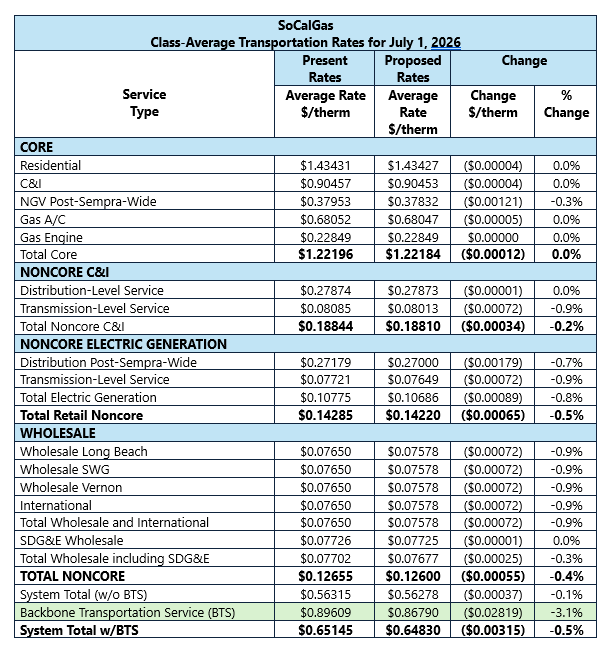
INSTANT ANALYSIS: The filing provides large backbone shippers with a meaningful July 1 rate reduction. The filing also illustrates that SDG&E-related transmission cost recovery moves through SoCalGas rates because the Southern California gas transmission system doesn't track neatly with utility service-territory lines.
ENERGY EFFICIENCY
California's four large IOUs filed their semiannual Independent Evaluator reports on third-party energy efficiency solicitations, a recurring compliance check the CPUC created in 2018 to oversee the outsourcing of program design and delivery to non-utility implementers.
These aren't performance evaluations; they're process reports, assessing whether solicitations ran fairly and flagging where procurement is breaking down. This round covers October 2025 through March 2026 and arrives as the IOUs push the CPUC to loosen the third-party framework in their 2028–2035 business plans.
SDG&E
SDG&E has nothing to report. Its last solicitations closed in spring 2025, and this filing is now its third consecutive period announcing no activity.
PG&E
PG&E still has two statewide solicitations moving:
- A $6.7 million "Career and Workforce Readiness" program, targeting Disadvantaged Workers under CPUC-defined eligibility criteria (income thresholds, incarceration history, foster-care emancipation) for placement in EE and electrification jobs. This program is currently in contract negotiations.
- A $30 million, four-year all-electric nonresidential HVAC solicitation, originally scoped as "Market Support" before PG&E reclassified it mid-design as "Resource Acquisition." This program is moving through bidder evaluation.
SCE
SCE's "Statewide Midstream Plug Load Appliance" solicitation required a 1.0 Total Resource Cost ratio just to advance an offer to evaluation. The independent evaluator recommended lowering that to 0.85, arguing cost-effectiveness should be judged at the portfolio level, not the offer level. SCE refused, holding that it won't contract for programs that can't forecast a 1.0 TRC ratio.
Bidder feedback backed the independent evaluator. Fewer than 10% of measure permutations were cost-effective at the program's $40 million scale before administrative costs, and five measure packages had none.
The evaluator also stated that proposing initial program design is a third-party implementers' job, not the IOU's. SCE's evaluation team concluded the program's viability risks were unresolved, declined to move to negotiations, and the $40 million solicitation then shut down.
SoCalGas
SoCalGas filed the most active report. It shows the opposite failure mode: not a fairness problem, but solicitations getting stuck in execution. Its "Residential Window Retrofit" pilot (IDEEA Round 3) sat in CPUC measure-package review for over a year. That process is supposed to run 20 days preliminary and 35 days complete-package, but the clocks only start once a complete package is on file, and repeated incompleteness findings kept resetting them.
Mid-review, the CPUC also tripled its cost assumption for the underlying window measure, forcing both sides to revisit whether the pilot was still worth pursuing before agreeing to continue. Approval finally came on March 31, 2026. SoCalGas's Large Commercial solicitation became a re-solicitation entirely because the incumbent contractor walked away in late January, then fell further behind amid procurement review group pushback over bidder-selection rationale and how much meter-based savings the program should capture. SoCalGas told its own independent evaluator the contract had to close by year-end specifically to hit the 60% third-party threshold, the same requirement it's now asking the CPUC to convert into a soft target.
INSTANT ANALYSIS: These filings detail an IOU retreat from mandatory third-party outsourcing, and the strongest evidence isn't in the business-plan proposals themselves; it's in what already broke during this reporting period.
SCE shows what happens when an IOU holds its cost-effectiveness line against the independent evaluator and bidder pushback: the program doesn't get redesigned, it dies before contracting.
SoCalGas shows the inverse problem, where even a utility actively trying to move forward gets stalled by CPUC review mechanics, procurement review group scrutiny, and contractor turnover, turning solicitation logistics into the bottleneck rather than the solicitation design itself.
SCE's bidder data suggests the plug-load program may have been unbuildable at its $40 million scope regardless of who controlled the design. SCE's insistence on control didn't just override third-party flexibility, it surfaced a scoping problem faster.