SoCalGas/SDG&E 2027 CAP: Embedded Cost Gains Ground as Intervenors Fracture
On June 15, parties served rebuttal testimony in SoCalGas/SDG&E's 2027 Cost Allocation Proceeding ("CAP," A.25-09-014). SoCalGas/SDG&E (the Sempra Utilities) and the following intervenors served rebuttal testimony:
- Clean Energy;
- Indicated Shippers;
- Southern California Generation Coalition (SCGC);
- TURN; and
- Western Manufactured Housing Communities Association (WMA).
On the biggest question in the proceeding, whether to retire Long-Run Marginal Cost (LRMC) and make embedded cost the universal allocation method, the applicants' submission is strong. The ultimate question is "who will pay," which has intervenors fractured.
Recall that the Sempra Utilities provided the following illustrative rates when they filed the CAP in September 2025.
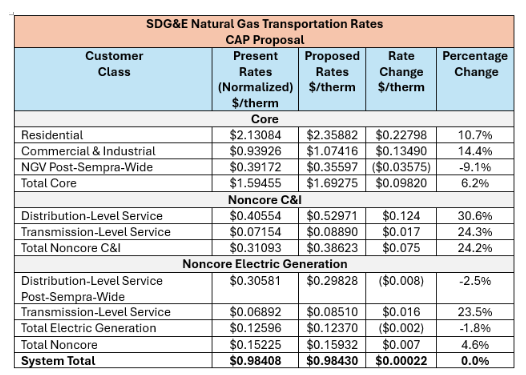
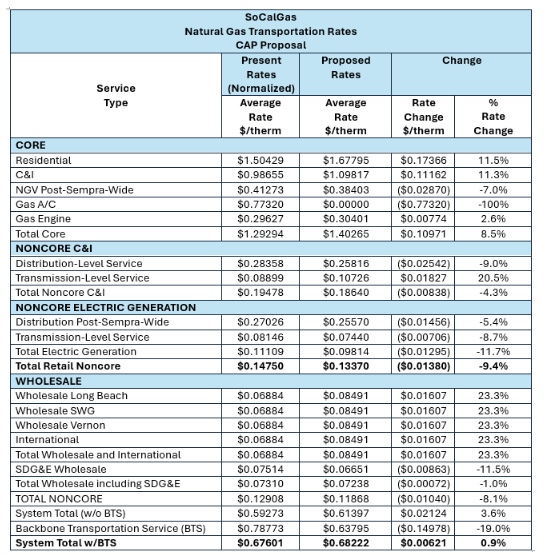
Links to all parties' testimony submissions are at the bottom of this post.
SUMMARY OF REBUTTAL TESTIMONY
- The Sempra Utilities' rebuttal returns to one argument across 10 chapters: each proposal rests on recorded-cost evidence, and intervenors must justify any departure from cost causation.
- Sempra witnesses Frank Seres/Marjorie Schmidt-Pines defend embedded cost as universal and move to discontinue LRMC.
- Sempra witness Michael Foster's residential fixed-charge chapter is the cleanest execution of the burden-shift; he casts the below-cost charge as the thing requiring justification, and his strongest factual point is the CARE inversion: approximately 80–82% of CARE customers subsidizing about half of non-CARE customers. He also states that incentivizing electrification through gas ratemaking and promoting gas affordability are "diametrically opposed principles."
- On methodology, the major cost-allocation intervenors mostly agree with the Sempra utilities. The Indicated Shippers, Clean Energy, and TURN all back the migration to embedded cost, and SCGC supports the framework as consistent with longstanding policy; only Cal Advocates holds out for LRMC. Clean Energy's witness Allison Smith makes a compelling case: LRMC was adopted in 1992 to send growth-era investment signals, and a shrinking customer base removes that rationale (which Cal Advocates' own witnesses concede).
- The deepest divide is intervenor-versus-intervenor. Witness Brian Collins (Indicated Shippers) argues peak-day demand sizes the system; witness Mike Florio (TURN) argues that with load declining and spending now safety-and-reliability-driven, annual throughput is the true cost driver. Florio's package shifts about $67 million onto retail noncore customers; Collins attacks it adjustment by adjustment, and Clean Energy joins him, noting an approximate $17 million (30%) hit to the NGV class tied to transit agencies facing about $1.3 billion in budget cuts.
- On distribution allocation, Florio is isolated; the applicants, Indicated Shippers, and Clean Energy all oppose his throughput allocator. TURN is not uniformly opposed, though: Florio backs the applicants on median storage capacity, equal-cents-per-therm load balancing, and assigning 12 Bcf to load balancing, though TURN and SoCalGas/SDG&E describe the current baseline differently.
- Two issues unite the cost-allocation intervenors against the utilities. The backbone-to-local-transmission reallocation (approximately $116.4 million) faces broad opposition, but the opponents don't agree on a remedy: SCGC's 8%, Cal Advocates' peak-month-with-residential-carve-out, and Indicated Shippers' peak-day method all compete with the applicants' about 20%. And the Firm Access and Storage Rights Memorandum Account (FASRMA) is the clearest intervenor target: Collins says SoCalGas would use an approximate $27 million Noncore Storage Balancing Account overcollection to eliminate an approximately $4 million the FASRMA undercollection tied mainly to stranded off-system delivery capital, against a program that generated only about $30,000 in net interruptible off-system delivery revenue.
- On Asset Retirement Obligations (AROs), TURN and the Indicated Shippers want AROs excluded; the applicants and SCGC want them in, with witness Cathy Yap leaning on FERC and prior CPUC treatment of AROs as plant cost. WMA's Mary Neal is narrower, arguing only that mobile-home-park operators, not tenants directly, bear the submeter-discount effect.
INSTANT ANALYSIS
SoCalGas/SDG&E seem well-positioned to win the methodology argument: embedded cost is headed for adoption with the major cost-allocation intervenors largely aligned and Cal Advocates isolated. What the applicants have not secured is the allocation outcomes that flow from a methodology win. Embedded cost is a framework, not an answer, and once the framework is agreed upon, the dispute moves to allocators, where the intervenors cannot agree among themselves.
That plays to the utilities' advantage. A Commission facing one unified opposition number can adopt it; a Commission facing Collins's peak-day theory, Florio's annual-throughput theory, and three different backbone calculations has more reason to defer to the filed study. The exception is FASRMA, where opposition among the cost-allocation intervenors is unified and the factual record is lopsided enough that the applicants are likely to lose it outright.
A key point is that every allocator dispute is ultimately about who absorbs the cost of a shrinking system. The Indicated Shippers and TURN disagree over whether industrial noncore or residential core carries it; Clean Energy is fighting to keep it off transit fleets.
For a gas-only utility with no electric pivot, securing cost-based allocation now (before the customer base contracts further) is the name of the game.