California SB 254 Report Warns of Rising Wildfire Costs, Insurance Strain, and Utility Liability Pressure
On April 7, the California Earthquake Authority published a Senate Bill 254 "Study Report," which frames California's natural catastrophe problem as three interconnected systems under compounding strain:
- A contracting insurance market;
- Financially pressured electric utilities; and
- Communities facing escalating wildfire exposure.
The report's central argument is that these are not separate problems (stress in any one domain amplifies pressure on the others), with costs flowing in every direction to ratepayers and policyholders. Doing nothing has a quantifiable price, and the report attempts to establish that price as a baseline for evaluating solutions.
The report organizes policy options around three pathways:
- Intensifying community-level wildfire mitigation;
- Reallocating catastrophe burdens across ratepayers, shareholders, and the public; and
- Expanding the State's direct role in financing and backstopping wildfire risk.
The report holds that resilience requires coordinated action across government, utilities, insurers, and communities (what the it calls a "whole of society" approach) that balances safety, affordability, and long-term climate goals against the escalating cost of inaction.
CPUC commissioner Darcie Houck mentioned the report during today's CPUC voting meeting, in the context of the Commission's substantial new rate-design OIR:
I'm pleased to see the SB 254 report was issued this week and provides some very good recommendations. The legislature is going to be looking at that, and as the conversation and this rulemaking continues – and we address the challenging and wide-ranging implications for communities – we're going to need to be having that conversation, both within the rulemaking and with external entities that are going to help provide policy direction on how we address these issues.
See CRI's April 9 voting meeting coverage here.
 MC
MC
INSTANT ANALYSIS
This report is a serious warning with a policy menu attached. It acknowledges that California's current model (strict utility liability under inverse condemnation, cost socialization through rates, and a retreating private insurance market) was designed for a loss environment that no longer exists.
The Eaton Fire has likely exhausted or critically impaired the California Wildfire Fund. SCE was downgraded to BBB-minus in September 2025. The FAIR Plan now covers nearly 39% of homes in very high fire risk areas. The existing framework is failing.
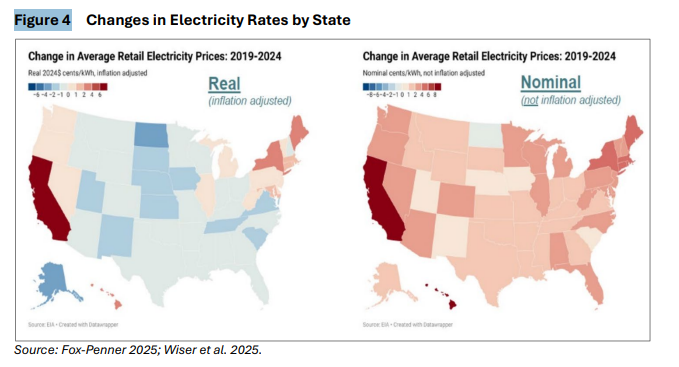
Three dynamics drive the cost-of-inaction analysis. Wildfire liability costs are no longer recoverable from episodic events, they are accumulating as a baked-in charge on utility finances. Inverse condemnation and the cost-of-service model ensure that those costs migrate to ratepayers whether utilities are solvent or not. And private insurance, the traditional first-line shock absorber, is in active retreat from high-risk areas, concentrating residual risk in the FAIR Plan and, ultimately, on the State.
The report's pathways highlight where the legislative conflict lands. Community mitigation is the least controversial and the slowest to show results. Liability reform (particularly around inverse condemnation) is where the most acute conflict sits, because it determines whether wildfire losses fall on shareholders, customers, or taxpayers. A State backstop and State-sponsored insurer options (Pathway 3) are the endgame scenarios: explicit acknowledgment that if the California Wildfire Fund model cannot be meaningfully reconstituted, Sacramento will absorb the residual effects.
The report should be read as a precursor document for rate-design proceedings, Wildfire Fund successor negotiations, and liability reform legislation that will run through the CPUC and multiple legislative venues simultaneously. Utilities, Community Choice Aggregators, large customers, and insurers are all exposed to the cost-allocation battles this report is setting up. The conflict over who pays, how much (and through what mechanism) is taking center stage.