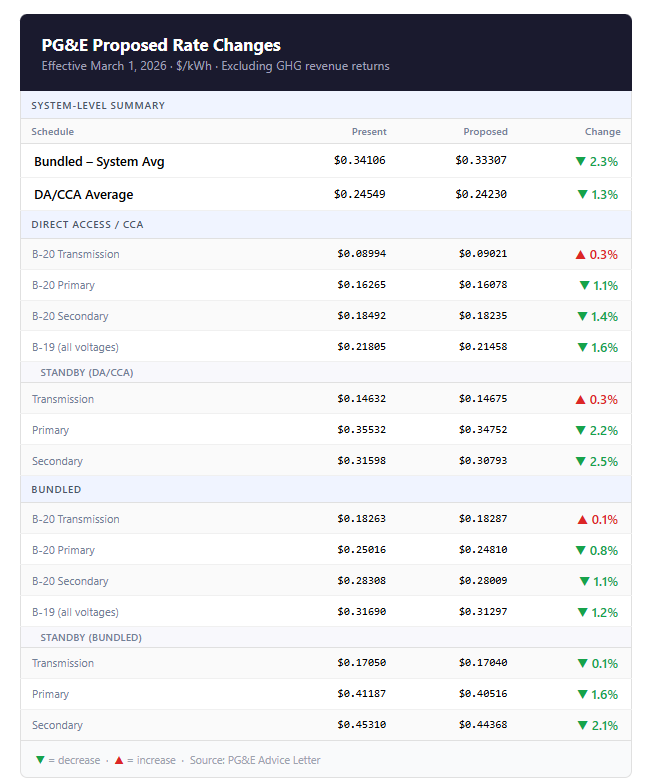
PG&E March 1 Filing: B-20 Transmission Rates Edge Up While Average Delivery Rates Decline (Bundled −2.3%, DA/CCA −1.3%, Excluding GHG Returns)
PG&E submitted Advice Letter 7846-E to implement electric rate and tariff changes effective March 1, incorporating multiple revenue requirement adjustments and rate-design directives previously approved by the CPUC and FERC.
The filing produces modest average rate decreases (about 2.% for bundled customers and 1.3% for Direct Access and Community Choice Aggregation customers for PG&E-provided services) while updating numerous cost components, including transmission balancing account charges, wildfire mitigation cost recovery, securitization bond charges/credits, and other balancing-account true-ups.
In parallel, the advice letter finalizes major changes to residential rate design mandated by prior CPUC decisions, most notably the rollout of an income-graduated fixed Base Services Charge (approximately $6/month for CARE customers, about $12 for FERA or income-qualified households, and $24.15 for all others). This charge is intended to improve affordability and support electrification policy goals.
The filing also adjusts certain minimum bill levels for inflation, closes obsolete balancing accounts, updates wildfire hardening bond recovery charges, and implements tariff revisions reflecting these changes. Protests are due March 19.
INSTANT ANALYSIS
This filing is a classic “rates down, bills restructured” package: small volumetric decreases that will be partly offset (especially for many residential customers) by the new fixed charge architecture.
The Base Services Charge shifts cost recovery away from usage and toward fixed revenue stability, which reduces conservation price signals and makes load growth (including electrification) less financially risky for the utility.
For CCAs and Direct Access providers, the modest delivery-rate reductions slightly improve the optics of non-utility supply but do not materially change competitive positioning; the bigger implication is that the fixed charge dampens the bill savings customers perceive from switching suppliers.
In sum, the advice letter shows wildfire financing, securitization, and infrastructure cost recovery continuing to flow through rates in incremental layers, reinforcing that California’s affordability problem is being managed through rate design engineering rather than cost containment.