FRIDAY AGGREGATE: CPUC Staff Move to Collapse Gas Carbon Value in ACC, IOUs Note DR Capacity Cliff, PG&E Breaches Backbone Floor
Below are items in today's briefing.
- AVOIDED COST CALCULATOR: The CPUC is updating the calculator that sets the dollar value of rooftop solar exports, batteries, and energy-efficiency programs. The current proposal would significantly cut the carbon credit for gas-displacing measures like building electrification, while shifting hourly value away from summer afternoons (and toward winter and weekday peaks).
- DEMAND RESPONSE: PG&E and SCE filed annual reports on how their DR programs are performing and how much they expect to deliver through 2036.
- DIABLO CANYON: The IRS ruled that a special Diablo Canyon customer fee counts as PG&E's taxable income, meaning about 29% of every dollar collected goes to taxes instead of the energy programs the fee was designed to fund. This is a loss for consumer advocates who pushed for the ruling and hoped for the opposite result.
- GAS LINE EXTENSION ALLOWANCE: SoCalGas says a garbage hauler needed new gas service because electric trucks aren't sufficient for the job. An ALJ ruling offers the company a chance to provide evidence.
- NATURAL GAS BACKBONE TRANSMISSION: On April 23, PG&E dipped below the state's mandated pipeline capacity minimum because three pipeline stations were all shut down for maintenance simultaneously. The shortfall was small and PG&E fixed it the same day by rerouting more gas through a different pipeline coming from Arizona.
AVOIDED COST CALCULATOR
A new ruling in R.22-11-013 issues Energy Division's 2026 Avoided Cost Calculator Staff Proposal for party input. The ACC sets Net Billing Tariff export credits, DER program screens, and storage and electrification portfolio economics across the state, so these routine updates deserve close attention.
Staff want to collapse the gas-sector carbon value onto the electric-sector value from the Integrated Resource Planning framework. Three pieces move together:
- A single cross-sector value;
- Removal of the Rebalancing adjustment; and
- A cap at the high societal cost of carbon.
Energy Division is pushing for all three to be adopted as a set.
The table below shows that by 2054 the gas carbon value runs near $1,200/tonne while the electric and societal values sit near $550. Collapsing gas onto the electric curve could significantly reduce the long-run carbon-driven value case for Renewable Natural Gas, gas efficiency, and building electrification.
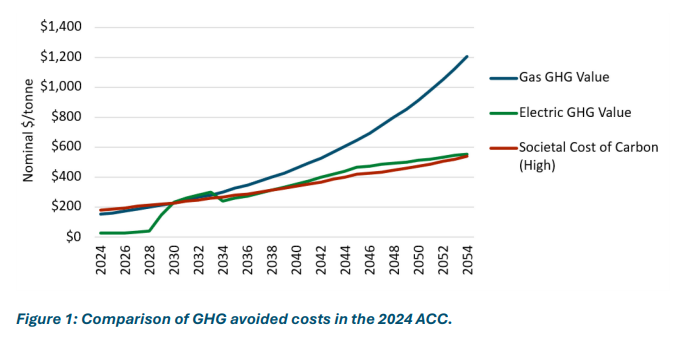
Staff defend the move by arguing the current gas number was always a placeholder figure from a 2021 CEC study that never lined up with the CPUC's main planning model, and that rebuilding it properly belongs somewhere other than this proceeding. The practical effect is that the gas carbon number is now driven by IRP inputs rather than developed inside R.22-11-013.
Staff are also scrapping the 2024 model that jointly calculates capacity and carbon values. That version ran in Python, and parties complained it was a black box: small changes to inputs from the CPUC's planning models produced large, unpredictable swings in the outputs. The replacement is a simpler Excel calculation that parties can open and audit directly. Staff bracket the result with a ceiling at the high societal cost of carbon and two floors:
- One tied to the operating cost of keeping existing gas plants online for reliability; and
- The other tied to Cap-and-Trade allowance prices.
Ratepayer advocates will want the ceiling lower. Clean-energy parties will want the floors gone.
Hourly capacity allocation gets three refinements:
- Frequency of loss-of-load replaces magnitude;
- SERVM energy prices replace temperature for identifying stressed days; and
- Weekday risk is split from weekend.
Staff point to planning models showing that the riskiest hours on the grid are shifting from summer afternoons to winter, as more solar, storage, and electric buildings change the shape of demand. Transmission allocation gets the same forward-looking treatment: instead of using 2023 CAISO load data for every future year, Staff will use the state's official load forecasts. The net effect is that hourly value moves toward winter peaks, evenings in spring and fall, and weekdays.
Under the new proposal, the important numbers (gas carbon, the floors, transmission allocation) are all imported from the IRP and state load forecast. A workshop will convene on April 29. Opening comments are due May 13, with replies due May 18.
INSTANT ANALYSIS: The new proposal reprices the gas-sector carbon value more than anything else. Staff pre-empted the main objection by casting the existing number as a placeholder, which shifts the conversation from whether to replace it to what replaces it. Electrification advocates and gas utilities end up on the same side of the ceiling question for different reasons: electrification loses valuation support as the gas curve compresses, gas utilities lose because sector carbon value now tracks electric decisions made elsewhere.
The bundling is deliberate. Parties who want to kill one piece have to explain why the other two should survive without it. The Python-to-Excel shift closes off model-integrity battles and pushes the proceeding onto policy ground, which disadvantages parties whose 2024 strategy leaned on black-box critiques.
The new hourly rules change what Net Billing Tariff exports, storage, and summer-afternoon DERs are worth. Rooftop solar compensation shifts without much fanfare, which is how ACC changes usually surface.
DEMAND RESPONSE
PG&E and SCE filed their 2025 Demand Response Load Impact Reports, giving the CPUC an 11-year forecast through 2036 and fresh inputs for Resource Adequacy planning.
- PG&E's portfolio runs three supply-side programs (Automated Response Technology, Base Interruptible Program, Capacity Bidding Program), four event-based load-modifying programs (Emergency Load Reduction Program, Peak Day Pricing, SmartRate, SmartAC), and residential Time-of-Use rates as the sole non-event resource. PG&E's forecasts follow protocols adopted in a 2024 decision (D.24-12-003), reported under both PG&E and CAISO peaking conditions.
- The BIP trajectory is the quantitative story: portfolio-adjusted impacts run 158–188 MW per month in 2026 and climb to 238–282 MW by 2036 (about 50% firm capacity growth from a single program). ART and CBP add 52–76 MW at summer peak; rate-design programs contribute 22–27 MW as price signals rather than firm capacity. An attached appendix confirms that BIP stays under D.10-06-034's emergency Demand Response cap.
- PG&E's weather methodology is still the December 2022 Resource Innovations memo built on 2012–2021 data. That memo recommends a two- to three-year update cycle. There is no refresh in the new filing. PG&E is now at the outer edge of its own methodology window.
- SCE's portfolio runs about two to three times PG&E's portfolio in peak months: 425–689 MW across 2026 under 1-in-2 conditions, against PG&E's 169–312 MW. Supply-side programs bid into the CAISO as Reliability Demand Response Resource or Proxy Demand Response; load-modifying programs reshape the net load curve.
- The Emergency Load Reduction Program is sunsetting, not continuing. A 2023 decision (D.23-12-005) extended select subgroups to 2027, but SCE's forecast zeroes ELRP impacts after that.
INSTANT ANALYSIS: The most reliable Demand Response in California still comes from a small number of large industrial and commercial customers who agree to cut power on short notice in exchange for capacity payments. PG&E's BIP and SCE's BIP-30 are doing the heavy lifting; everything else (residential thermostats, peak pricing, voluntary programs) is either a supplement or a price signal rather than firm capacity the grid can count on.
Three things matter for trading desks and utility procurement.
- First, there's a regulatory ceiling on how much emergency Demand Response can count toward Resource Adequacy requirements, and PG&E runs an annual test to show BIP stays under it. If BIP grows or performs better than forecast, that ceiling starts to bind and the RA math changes.
- Second, the Emergency Load Reduction Program (the pandemic-era summer reliability pilot) is set to end in 2027 at both utilities, removing a meaningful block of dispatchable capacity right as California heads into the next round of tight supply years.
- Third, PG&E is still using weather assumptions built on 2012–2021 data, past the refresh window its own consultants recommended. That introduces real uncertainty into the forecasts regulators use to decide how much new supply the state needs to build.
For large customers and aggregators, the value is in load that actually drops when called. Voluntary and behavioral programs build participation numbers but don't carry the same weight with planners procuring against worst-case conditions. The next round of CPUC decisions will hinge on performance under stress, not enrollment.
DIABLO CANYON
PG&E filed Advice 7897-E, notifying the CPUC that the IRS has ruled on the tax treatment of Diablo Canyon's Volumetric Performance Fees. The ruling: VPFs are taxable income to PG&E regardless of whether the money funds capital projects or operating expenses. This is the second of two IRS rulings ordered by a 2024 decision (D.24-12-033). The first, on depreciation treatment, came through Advice 7835-E.
The CPUC ordered PG&E to seek the ruling at TURN's urging, on the theory that a favorable tax answer could produce substantial ratepayer savings. TURN lost. The IRS found that PG&E has enough control over how VPF money gets spent (discretion over whether and how to use it, subject only to CPUC approval) that it counts as the utility's income when collected, not a pass-through held for ratepayers.
One question the IRS left open: when the tax hits. PG&E currently books VPFs as deferred revenue and recognizes them as costs are incurred. Whether that timing works for tax purposes is unresolved and could be litigated in future proceedings.
INSTANT ANALYSIS: This ruling forecloses PG&E's most favorable tax path on a program that isn't just plant O&M; the statute contemplates broader public-purpose spending, which is why TURN fought this. A tax gross-up at California's combined corporate rate (29%) is real money on a multi-hundred-million dollar program, and every dollar of tax leakage is a dollar not reaching the energy programs ratepayers are funding through VPF collections.
GAS LINE EXTENSION ALLOWANCES
In SoCalGas's gas line extension allowances application (A.25-07-001), a new ruling reopens the evidentiary record to allow SoCalGas to serve supplemental testimony supporting three statements about EV feasibility for a refuse hauling customer, specifically that:
- Electric trucks lack the range for required routes;
- High ancillary hydraulic loads for lifting and compacting refuse constrain EV options; and
- Battery and fuel-cell EVs remain infeasible for heavy-duty trucking due to upfront costs, limited infrastructure, restricted range, and extended refueling times.
SoCalGas may provide its supplement by May 18; intervenors may rebut by June 2. Cal Advocates and Sierra Club had argued the record lacked adequate support for these claims. SoCalGas countered in rebuttal that a 2022 decision (D.22-09-026) "does not specifically require the submission of such customer evidence." The new ruling implicitly rejects that reading.
INSTANT ANALYSIS: The ALJ is siding with intervenors on evidentiary sufficiency over SoCalGas's interpretation of D.22-09-026. For utilities pursuing gas line extensions where electric alternatives are in dispute, the governing decision is being read to require customer-specific proof even where the utility argues it doesn't. Fleet operators and large-load developers on the customer side should expect their own operational constraints to become part of the evidentiary record.
BACKBONE TRANSMISSION
On April 23, PG&E's Cycle 1 backbone transmission capacity fell 106 MMcf/d below the minimum design standard, the average day in a 1-in-10 cold and dry year, which was set at 2,493 MMcf/d for 2026 under a 2006 decision (D.06-09-039).
Cycle 1 available capacity came in at 2,387 MMcf/d (Redwood 1,740 + Baja-Topock 630 + California Production 17). PG&E restored compliance intraday by lifting Baja-Topock capacity to 800 MMcf/d.
The breach traces to three concurrent maintenance events:
- Burney Station, Redwood Path (April 23–24);
- Topock Station, Baja Path (April 23–24); and
- Antioch Station, Redwood Path (April 23–May 12)
INSTANT ANALYSIS: PG&E got back above the threshold by moving volumes between paths in real time, not because the system had spare capacity sitting around. Baja-Topock went from 630 to 800 MMcf/d (a 170 MMcf/d increase to cover a 106 MMcf/d shortfall), leaving about 64 MMcf/d of cushion on the path carrying the load.
Burney and Topock wrapped in a day. Antioch runs until May 12. The same Redwood Path impairment will stay in place for three more weeks, and whether PG&E stays above the threshold depends on Baja-Topock continuing to carry the load.
This filing exists because a 2022 decision (D.22-07-002) created the first-day reporting requirement. Pre-2022, a one-day breach wouldn't have surfaced publicly. Watch for another threshold-breach notice before May 12. One is routine maintenance; a second on the same outage would suggest the system can't cover this window without breaching the floor, and would give intervenors an argument against backbone downsizing.